
Pickens County celebrates Carolina Day on June 28 at Old Stone Church and Hopewell: Clemson University Historian Dr. Otis Pickett presents program titled 'Andrew Pickens as a Presbyter, Elder, and Churchman'
By Karen Brewer, Publisher & Editor, The Pickens County Chronicle




Bud Starnes, President of the General Andrew Pickens Chapter of the Sons of the American Revolution (SAR), leads a tour of Patriot graves at Old Stone Church on June 28, 2026. (Photos by Karen Brewer, The Pickens County Chronicle)


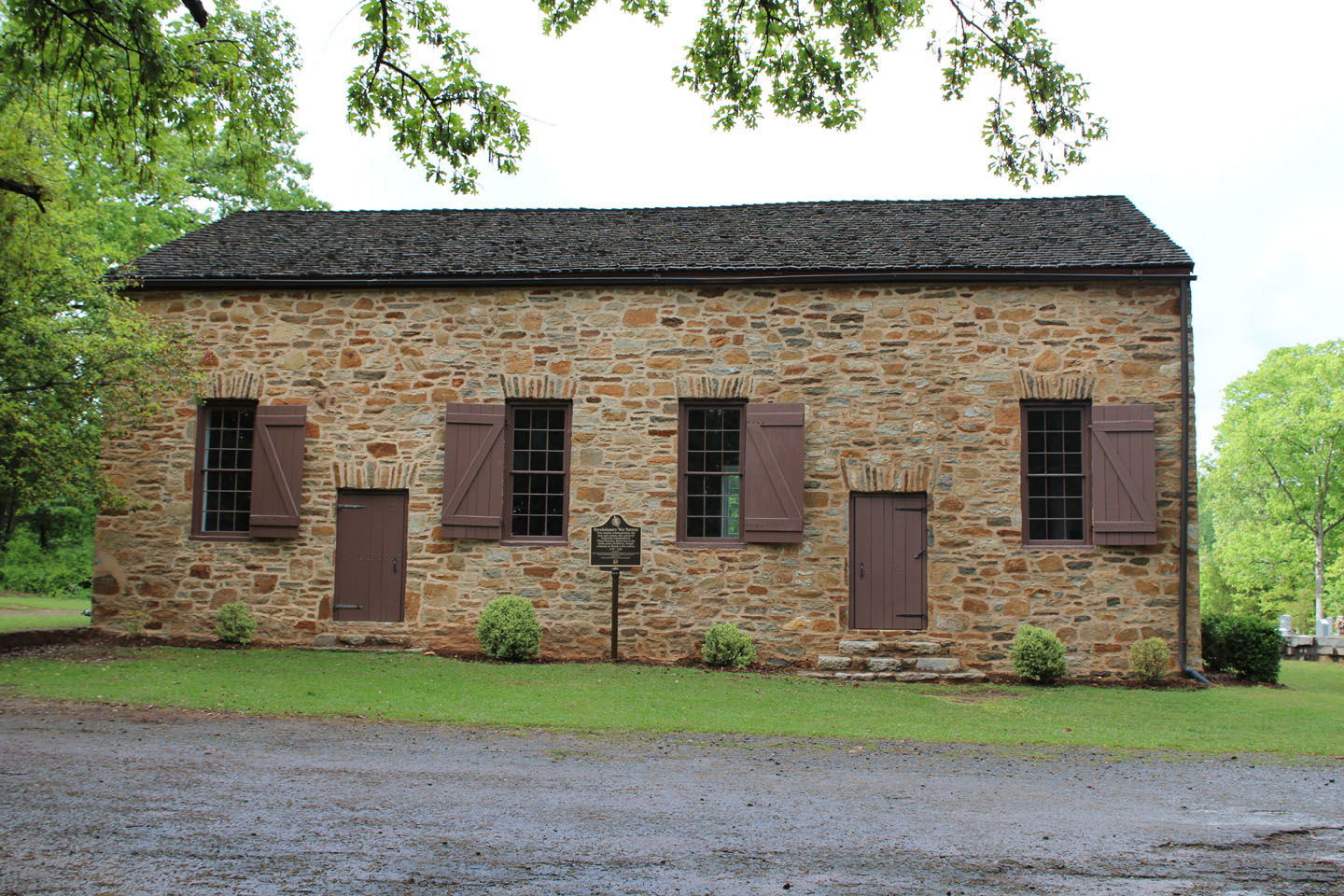
Carolina Day was celebrated in Pickens County the afternoon of Sunday, June 28, 2026 at Clemson’s Old Stone Church (the final resting place of Pickens County’s namesake, Revolutionary War General Andrew Pickens, and his wife, Rebecca Floride Calhoun Pickens) and Hopewell Plantation, their former home. The event included a tour (led by Bud Starnes, President of the General Andrew Pickens Chapter of the South Carolina Society Sons of the American Revolution) of Revolutionary War Patriots’ gravesites at Old Stone Church, a presentation by Clemson University Historian Dr. Otis Pickett inside the historic church, a speech by Pickens County America 250 Committee Chair Carolyn Nations, an open house of the historic Hopewell home, and book signings by Dr. Otis Pickett (author of Southern Shepherds, Savage Wolves: Presbyterian Domestic Missionaries and Race in South Carolina 1802-1874), Dr. Rod Andrew (author of The Life and Times of General Andrew Pickens), Karen Petit (author of children’s books, including Celebrate America! The People Declare Independence), and Kate Salley Palmer (author of children’s books, including Palmetto: Symbol of Courage). Sponsors for the event were the Pickens County America 250 Committee, Clemson University Historic Properties, Old Stone Church and Cemetery Association, General Andrew Pickens Chapter of the South Carolina Society Sons of the American Revolution (SAR), and the Fort Prince George Chapter of the Daughters of the American Revolution (DAR).
Carolina Day commemorates the June 28, 1776 Patriot victory over the British Royal Navy, as a small group of patriots, led by Colonel William Moultrie, defended Fort Sullivan, made of palmetto logs, in the Charleston Harbor. The palmetto tree became a symbol for South Carolina and is featured on the state flag of The Palmetto State.
Carolina Day was observed in Pickens County not only to celebrate the victory at Sullivan’s Island but also to recognize the Patriots from the Upcountry of South Carolina, including General Andrew Pickens, for whom our county was named.
The event began at 2 p.m. with Bud Starnes, President of the General Andrew Pickens Chapter of the Sons of the American Revolution (SAR), leading a cemetery tour of gravesites of Revolutionary War Patriots. The Old Stone Church cemetery includes the gravesites of 16 known Revolutionary War Patriots, including General Andrew Pickens and his wife, Rebecca Floride Calhoun Pickens, and, in alphabetical order, Robert Anderson, Nicholas Bishop, John Garvin, David Lewis, John Miller, Robert Miller, Thomas Ogier, Alexander Ramsay, George Reese, Rev. Thomas Reeese, William Steele, Jane (Jeanette) Lamant Walker, William Walker, and Joseph Whitner.
A new marker was placed in November of 2025 at the gravesite of General Robert Anderson, for whom Anderson County is named. Anderson, Starnes noted, served under General Andrew Pickens. “He later became a General, himself,” said Starnes. “He was sort of Andrew Pickens’ right-hand man, even here at the church.”
John Miller, a printer in England who defended a free press and defended the Colonists, moved to South Carolina. He provided land for Old Stone Church and its cemetery, Starnes noted. Miller was the state printer, publisher of the first daily newspaper in South Carolina, and founder of the first newspaper in the Upcountry.
Starnes noted that the website for Southern Campaigns of the American Revolution (www.Southern-Campaigns.org) is a good reference for pension applications on Revolutionary War soldiers, but he noted that pension applications did not start until 1831, and many Revolutionary War soldiers had already passed away by that time.
Following the cemetery tour, a Carolina Day program was held inside the historic Old Stone Church, where Andrew Pickens once worshiped.
Dr. Otis Pickett, Clemson University’s Historian and Chief Administrative Officer for Clemson University Historic Properties, welcomed the crowd. “This is a historic event,” Pickett said, “because this is the first time we have celebrated Carolina Day in Pickens County, to my knowledge.
“Part of my life is about building bridges,” he said. “I grew up in Charleston, South Carolina, and I grew up on Sullivan’s Island. We celebrate Carolina Day really big. One thing that I wanted to see, moving here, moving back home to Clemson, is Pickens County and the Upcountry properly celebrate it for the role it played in securing our nation’s freedom. Thank you for coming out today and helping us commemorate that and show the significance of that, of what this area played in the American Revolution. That’s the hope for today.”
Pickett then introduced Rev. Laura Conrad, of Fort Hill Presbyterian Church, who opened with prayer.
Pickett noted the importance of Carolina Day. “It’s a significant day in South Carolina’s history, with the Battle of Sullivan’s Island. I was really blessed to grow up on that island as a young man, and we learned very early about the important role that this island played. They actually call Sullivan’s Island the obstinate daughter of the South. And this victory is a very, very significant victory, just after Bunker Hill, of repelling the British from being able to invade Charleston, South Carolina. A few hundred men behind several palmetto logs were able to prevent a very large and overwhelming force from capturing Sullivan’s Island and putting pressure on the City of Charleston that would have been under artillery barrage had they captured Sullivan’s Island. And, so, that victory prevented the British from invading our key port city for four years. Had the British won that, largely, the role of South Carolina would have been much more subdued, as the British would have used that port city as a landing place to bring in troops and begin to invade into the backcountry and begin to put pressure on southern Virginia. And, so, the fact that Colonel William Moultrie and those soldiers kept Charleston from being attacked and fallen for four years is one of the most significant things in the southern theater of the American Revolution. So, that is why it is such a big thing in Charleston.
“Why we’re bringing it here is we have such an amazing American Revolutionary heritage in Pickens County.”
He thanked the members of the General Andrew Pickens Chapter of the Sons of the American Revolution (SAR) and asked them to stand and be recognized. “Thank you for keeping the heritage and legacy and history alive in this county,” he said, adding, “We also want to thank you for these amazing beautiful flags that have been donated to the Old Stone Church. As a board member of the Old Stone Church Historical Association, I want to offer you our committee’s thanks and gratitude.”
He introduced Eric Barnhill of the General Andrew Pickens Chapter of the SAR, who spoke about the hand-stitched flags that the Chapter donated to Old Stone Church. After finding out from the church that there were no flags, Barnhill said, “The current President, Bud Starnes, made poles, and we bought the flags and wanted to present them to the church.”
Pickett then recognized members of the Daughters of the American Revolution (DAR) who were present and asked them to stand and be recognized. His mother was in the DAR, he said, and he was able to fill out his application for the SAR because of her research. “I think every man in this room can attest to the women who make sure the memory of the people who fought and served is held up and celebrated across time. If that’s not done, so much of this memory gets lost. So, thank you, ladies, for your incredible work. We appreciate you so much.”
He then recognized descendants of Andrew Pickens who were present and asked them to stand.
“I also want to thank the Old Stone Church Cemetery Association who maintains this building, who maintains the cemetery. If you’re a member of that committee, would you please stand and receive our thanks today.”
Pickett then introduced Carolyn Nations, Chair of the Pickens County America 250 Committee and immediate past Regent of the Fort Prince George Chapter of the Daughters of the American Revolution (DAR). He spoke about her passion for championing Andrew Pickens and the American Revolution, teaching adults and children. “Carolyn, I just want to thank you, from the bottom of my heart, for all that you’ve done to make sure we celebrate Andrew Pickens.”
He noted the exhibit on Andrew Pickens that opened at the Pickens County Museum of Art & History last year, as well as the General Andrew Pickens and Revolutionary War Patriots monument dedicated on June 6, 2026 at Legacy Square in Pickens.
“When they asked me to be the 250 Chair,” Nations commented, “I said, ‘Only if I get to talk about Andrew Pickens wherever I go.’” She asked everyone to ring bells at noon on July 4. “That’s a national initiative this year,” she said. She then thanked Pickett “for all that you do, and your history department.
“We are honored that you have joined us here today as we remember the courage, sacrifice, and determination of the South Carolina Patriots who helped secure the cause of American liberty,” she told the crowd gathered inside Old Stone Church. “Carolina Day reminds us that freedom was won through the bravery of ordinary men, such as our county’s namesake, General Andrew Pickens, as well as the other men and women throughout South Carolina who were willing to stand for something greater than themselves. Today, as we gather in this historic place, we honor their service, preserve their stories, and renew our responsibilities to pass their legacy on to future generations. On behalf of the Pickens County 250 Committee and all of our sponsoring organizations, thank you for being here and for sharing in this meaningful observance. We hope today’s program will inspire each of you to remember with gratitude and reflect with pride and continue telling the remarkable story of South Carolina’s role in the American Revolution. As we remember and celebrate this Carolina Day observance, we remember that liberty was not secured by one battle, one leader, or one moment of courage. It was secured by men and women who stood when standing came at a great cost. Here, at Old Stone Church, we have walked among the graves of patriots who answered the call of freedom. They left their homes, their families, and the safety of familiar places, because they believed that liberty was worth defending. General Andrew Pickens stood with the backcountry militia through defeat, hardship, and uncertainty. He stood at Kettle Creek, Cowpens, Ninety Six, and Eutaw Springs. He stood for his neighbors, for South Carolina, and for the promise of a nation not yet fully born. Rebecca Pickens stood, as well. She endured the fear, loneliness, and danger carried by families who remained behind. She protected her home, cared for her children, and shared the burdens of war. Her courage may not have been displayed on a battlefield, but it was courage, nonetheless. The militia stood beside General Pickens. The women stood beside their families. The people of the backcountry stood together, and, because they stood, the cause of liberty survived. Today, as we leave Old Stone Church and gather at Hopewell, the home of Andrew and Rebecca Pickens, may we remember that we are not merely visiting historic places. We are walking upon grounds shaped by sacrifice, courage, and faith. They stood for the liberty we inherited. May we stand for the liberty we must preserve. Liberty lives here, in these sacred places, in the stories we remember, and in the hearts of all who refuse to forget. Thank you.”
“Thank you, Carolyn, for such a great, amazing talk,” said Pickett. “And thank you so much for all you do to keep that memory alive. We appreciate you.
“What a great honor it is to be here today,” Pickett told the crowd. “As a Clemson person, I want to thank some of my people who are here that mean so much to me and invested so much in me, to come home and work at my alma mater.” He noted the presence of Dr. Jim Barker (who served as Clemson University’s President from 1999 through 2013) and his wife, Marcia. “Thank you for what you invested in my life and for leading our institution so well,” Pickett said. “I also want to thank my patient wife, Julie, who put with a lot over the years, of graduate school and so many different things and raised three beautiful amazing children.
“So many friends and folks who are here, thank you.”
Pickett, a Presbyterian, said that he wanted to share about the faith of Andrew Pickens and what it means to be a Presbyterian.
“I think religion provides a significant world view for people as they are thinking about who they are as autonomous citizens.
“A Presbyterian elects members to be on a session. As Andrew Pickens is a descendant of Presbyterians, he’s going to provide land for the establishment of a church. He also is elected, he’s recognized by the church body for his abilities as a shepherd. What is a shepherd? What is a good shepherd? I saw a great video the other day of a shepherd pulling a lamb out of a ditch. And it said, ‘This is me when I mess up and what the Holy Spirit does.’ He pulls the lamb out of the ditch. The lamb starts jumping and jumps right back in the ditch. A good shepherd goes and gets that lamb and leaves the other 99. And, so, a good shepherd of a congregation cares about every member, especially the children, especially those who are weak and on the margins, especially those who may not be able to attend, and makes sure they are cared for, they have instruction, that they know they are loved and they’re a member of the community. Andrew Pickens was recognized by his congregation to have those qualities. And, then, he’s elected as a ruling elder and represents the body on the session, which is a local governing body of the church. That session would make decisions like this: Who are we going to call as Pastor? They will call the very first Presbyterian minister to this area, from Charleston, South Carolina, a man named James McElhenny, who will pastor in this church. They’ll make decisions like this: What should we do with the enslaved? Should the enslaved in this area come and worship? And, when I launched my book, which is about Presbyterians and missions to the enslaved, I wanted to have my first talk in this church, because it’s one of the few churches in this county with a balcony where the enslaved would sit. And that is very significant, I argue in my book, because these Presbyterians cared enough to see enslaved people as having souls, as being human, as worthy of the dignity of coming to worship.
“There is also a significant relationship that Andrew Pickens has with the Cherokee,” Pickett said. He noted the presence of Dr. Rod Andrew, author of the book The Life and Times of General Andrew Pickens. “Andrew Pickens models, I think very well, and I think Rod Andrew’s book shows this very well, the mutual admiration and respect that Andrew Pickens had for the Cherokee and their warriors and the respect that they had for him.”
He noted that Hopewell was the site of treaties signed by the United States government and Native Americans. “It’s very clear that, as Andrew Pickens is negotiating with the Cherokee and later the Choctaw and the Chickasaw, there is a mutual respect of warriors that had fought one another and a mutual respect of these human beings who were engaging in a treaty with him in a way that brings dignity to them.
“I think, if Andrew Pickens were here today, he would say, ‘Do not honor me. Honor my God, my God of Abraham, Isaac, and Jacob, who is a covenant keeping God, who gave everything and loves me as a good son. And, brothers and sisters in this room, I want you to know you are loved by God. And I think Andrew Pickens would want us to know that. More than elevating him, I think he would want us to elevate his God that he served.
“We are wanting to do everything we can at Clemson University to celebrate the heritage of Andrew Pickens and Hopewell. Today, we’ve opened up Hopewell home for an open house. We have just spent money on an archaeological laboratory where we could host archaeological digs. We also have just finished our feasibility study of Hopewell. And our dream, my dream and the dream of my team and our director, is to turn that house into an interpretive center that will tell the story of Andrew Pickens, tell the story of the Cherokee, and tell the story of the enslaved Africans who lived on that land.
“Every summer, we host descendants of enslaved African Americans that were on the plantation. They come back every summer to have a family reunion. Last summer, we gathered in a circle, and we prayed together. And I think history and truth can be wonderful models for how we reconcile and come together, as a society. We can’t run away from these things. We press into them, and we press into them with love, with Christian love, and we press into them as human beings.
“If you’re a descendant here today, I want to get your feedback on how we’re going to do the interpretation of the Pickens family. We’re getting feedback from those family members in terms of how we’re doing the interpretation of the enslaved experience. We’re working with the Eastern Band of the Cherokee, so that we can get their interpretation. And wouldn’t it be beautiful, one day, if all three are gathered together singing a song, praying together, and coming together because of history. Wouldn’t that be amazing? And, so, I want to extend an invitation to you. Will you please be a part of that with me, so that South Carolina can model to the world — Here’s how we come together in a world that tells us we should divide. Let us show you how we do it here. We do it with dignity, respect, truth, and love. Amen?”
Pickett closed in prayer and invited everyone to Hopewell, a short drive from Old Stone Church, where the crowd enjoyed self-guided tours of the home and grounds.
Publisher’s Note: All of the above authors’ books are available from Amazon.