
"Giving voice to the mountains": Honoring the life of Dennis Chastain
By Karen Brewer, Publisher & Editor, The Pickens County Chronicle

Jane and Dennis Chastain on top of Sassafras Mountain the day of the dedication of the Observation Tower, April 22, 2019. (Photo by Karen Brewer)
Green — the color this writer always saw him wear – was appropriate for the outdoorsman, botanist, guide, interpretive naturalist, and conservation advocate, yet, in addition to having a love and respect for the outdoors, Dennis Chastain also had a love and respect for the written word, and for history, and he researched and evidently remembered everything he read. He has been called a Renaissance man as well as a Daniel Boone of our modern times.
His family and friends, this writer included, were shocked and saddened on Friday, November 21, 2025, when word came that he had passed away in his sleep. The news was quite unexpected for all, and his passing and absence will be deeply felt.
An award-winning writer, Dennis began writing for South Carolina Wildlife magazine in 1989 and wrote many articles for other publications, as well, including The Greenville Journal. An in-demand speaker, he has given slideshow presentations not only in Pickens County but in other parts of the Upstate as well as in western North Carolina. He also served as a guide, leading field trips for several groups, including Clemson University’s Master Naturalist program.
His most recent local speaking engagements included an August 1 lecture on Revolutionary War patriot Francis Salvador (held at the Madren Center at Clemson University), a June 28 Revolutionary War era slideshow presentation for Carolina Day (held at the Captain Kimberly Hampton Memorial Library in Easley), a January 16 slideshow presentation on The Cherokees of the Carolinas (held at the Pickens County Museum of Art and History), and a September 13, 2024 slideshow presentation of the Battle of Esseneca at an event celebrating the birthday of General Andrew Pickens (held at the Pickens County Museum of Art and History).
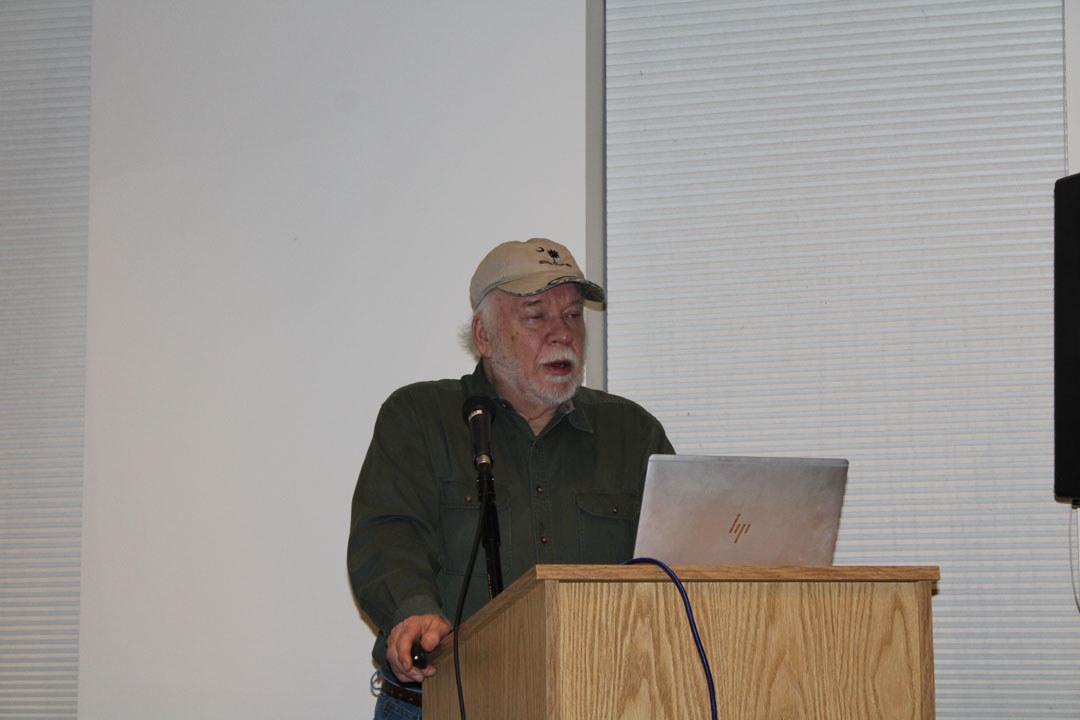
Dennis Chastain spoke and gave a slideshow presentation on The Cherokees of the Carolinas on January 16, 2025 at the Pickens County Museum of Art & History. (Photo by Karen Brewer)

Dennis Chastain spoke and gave a slideshow presentation on the Battle of Esseneca during a celebration of the birthday of General Andrew Pickens at the Pickens County Museum of Art & History on September 13, 2024. (Photo by Karen Brewer)
“He did so much for our Upstate, and he enjoyed it,” said his wife, Jane, while speaking with The Pickens County Chronicle. “Everything was so rewarding to him, and that was what he wanted. He did exactly what he wanted to do. He loved writing. He loved it from the aspect of being a storyteller. So, if he was writing articles or giving slideshows, it was all about telling stories, not just stating facts. A lot of people learned a lot from Dennis Chastain. Anytime somebody asked him, ‘Would you mind if we videotape?’ he said, ‘Please videotape, because, when I’m gone, all this information is gone.’ So, he welcomed anybody who wanted to tape it while he was talking or doing a presentation.
“When he died, I told the paramedic, ‘You have no idea how much knowledge just left this earth.’ He constantly amazed me, how much he knew and how smart he was. And the whole Upstate depended on him. People called him all the time and asked questions, searching for information, and he usually could answer their questions or guide them where they needed to go. There are going to be a lot of people that are going to miss his advice and his answers.”
Dennis and Jane married 46 years ago. They met while they both attended Winthrop College (now Winthrop University) in Rock Hill. “It was mostly a women’s college then,” said Jane, “and I have thought, so many times over the years, how did he pick me out of all of those girls? But he would tell you it’s the best decision he ever made. He’s told me that several times. He said it a lot, but it was very genuine. Dennis Chastain lived the life he wanted to live, and he lived it with who he wanted to live it with.”
Dennis and Jane moved to Pickens County in 1979, and they have lived on his family’s homeplace near Table Rock. “His Daddy grew up here,” said Jane. “Dennis is the seventh generation to live on this land. But his Daddy moved to Slater and had a barbershop in Slater, and that’s where Dennis grew up. And, then, he went to Winthrop. He went to Clemson and got sick, so he had to drop out, and he went to Winthrop. He said he got two degrees and found his wife there.”
Jane said that she has been overwhelmed by comments people have made about her husband. “I am just ‘blown away’ by how many people he impacted,” she said. “What a legacy.”
Dennis has served for many years as the Blue Wall Vice President for the Pickens County Historical Society, for which Jane serves as Membership Director. Wayne Kelley, Senior Vice President for the Pickens County Historical Society, shared with The Pickens County Chronicle his thoughts about his friend. “The sudden passing of the Pickens County Historical Society Blue Wall Vice President Dennis Chastain was a stunning moment for us all. It is still almost incomprehensible to us that he is no longer here. Dennis was unique. His sweeping knowledge of local lore, history, geology, and the flora and fauna of this place was unexcelled, and this he generously shared throughout our state in lectures and slideshow presentations. He and his life partner, Jane Fields Chastain, covered countless miles throughout South Carolina, among other things, tracing the historic Cherokee Trail from here in the Upcountry to Charleston harbor. Their teamwork resulted in numerous discoveries that added to the storied history of the Palmetto State. I cannot say how much he will be missed by so many, not only for his tireless achievements, but for his good humor and his friendship. It was an honor and a pleasure to work with him weekly on historical projects these many years. I’ve missed him these past few days and expect I always will.”
Dennis has also been serving, along with Jane, as a member of the Pickens County 250 Committee, which has been conducting and planning events to celebrate the United States’ upcoming 250th birthday. Carolyn Nations, who serves as the Chair for the Pickens County 250 Committee, spoke with The Pickens County Chronicle about Dennis following his passing. “He was amazing,” she said. “All the history that I learned from listening to him and talking to him, him giving me tidbits on research. He was one of a kind.” Nations is also the immediate past Regent of the Fort Prince George Chapter of the Daughters of the American Revolution (DAR). Ladies in other DAR chapters, she said, have commented on what a great speaker he was when he came to their chapters to speak and answer questions. She also called him a wonderful person. “His death leaves a void,” she added. “Our Historical Society has been hit hard with the death of Anne Sheriff and now Dennis, both of them brilliant.”
State Representative Davey Hiott, from Pickens, shared with The Pickens County Chronicle, “I was saddened to hear the news of his passing. I don’t know how you replace that much history — as much as he knew and as much as he retained. You don’t replace that in Pickens County, that’s for sure. He was just ‘a walking encyclopedia’ of history. I never met a guy that knew that much, and he basically learned it on his own. He was just a dear friend. He knew so much, and he wanted other people to know it. With he and Anne Sheriff both dying within a two-month period, we’ve lost an awful lot of history. He’ll certainly be missed. He was a good man. Not only was he a smart man and knew a lot about Pickens County, but he was a good friend.”
Longtime former State Senator Larry Martin, of Pickens, also spoke with The Pickens County Chronicle about Dennis Chastain. “Dennis was one of my all-time favorite people,” Martin said. “He meant a lot to Pickens County throughout his lifetime after he moved here. He was born and raised in Slater. Early on, when I got to know him, I talked to him about my growing up years in Dacusville. We’d go to the Marietta-Slater area. As a matter of fact, I played a lot of sports over there. They came to Dacusville, and we went to Slater. But he was four or five years older than me, so I never encountered him as a child or as a young person. But, when I got elected to the legislature, I first met him, and he just always impressed me as somebody that cared a lot about Pickens County and the Upstate, particularly from an environmental, natural resources perspective. He had a wealth of knowledge about anything environmental, anything natural resources. He was an avid sportsman. He could give you the particulars of any hunting season rule or regulation. And, oftentimes, when something pertaining to hunting, particularly in our area, would come up, I would call him and talk to him about it, because he was so knowledgeable and had such a good feel for what needed to be done or not be done. He was a terrific resource for me throughout my career in the legislature, and I just thought very highly of him and his wife, Jane, who was an educator. Both of them went to Winthrop. My wife went to Winthrop. And I think that’s where Jane and Dennis met, at Winthrop. I thoroughly, thoroughly enjoyed knowing Dennis Chastain and was so saddened to hear about his untimely and sudden passing. I was ‘blown away’ by it. It’s just incredible. I’m sure a lot of folks are going to miss Dennis Chastain. I know the Historical Society, the various natural resource and conservation groups around the Upstate that he was involved with, they’re going to really miss him and his participation and what he brought from a lifetime of experience.”
State Senator Rex Rice also spoke with The Pickens County Chronicle about Dennis Chastain. “He was an outstanding individual,” Rice said. “He had a lot of knowledge. It would be nice to have all the memories that he knew of everything he knew. He was always interesting to listen to. Let’s put it this way — when he was talking, he had your attention. He was a very sharp individual.”
More than 20 years ago, this writer, as the Editor of The Pickens Sentinel, rode with Dennis Chastain, mutual friend Pickens Mayor Ted Shehan, and a high school student shadowing Shehan that day to Pickens County’s Sassafras Mountain, the highest peak in the state of South Carolina. At that time, a United States Congressman from North Carolina wanted to build a home there, and Dennis, along with a mutual friend, Wes Cooler, thought, and rightfully so, that the land belonged to the people of South Carolina, and this writer wrote a news story about the need for South Carolina to preserve it. Thanks to their efforts, the State did purchase Sassafras Mountain, and, then, years later, on April 22, 2019, Earth Day, a ribbon-cutting ceremony officially opened the Sassafras Mountain Observation Tower, from which visitors can see impressive views of the three states of South Carolina, North Carolina, and Georgia. Among those attending the celebration that day were Dennis and Jane Chastain and Wes Cooler and this writer.
Former Pickens Mayor Ted Shehan spoke with The Pickens County Chronicle about Dennis Chastain, following his passing, and recalled those days. “Dennis meant so much to the conservation efforts in Pickens County,” Shehan said. “He worked tirelessly on the Sassafras Mountain property, which is now protected, and the Grant Meadow property, which is now protected. More people pull over and take pictures there, I believe, than anywhere in the Upstate. It’s beautiful.”
Shehan spoke about Chastain’s and Cooler’s statewide efforts regarding the protection of Sassafras. “Your articles here in Pickens County — and it made the Charleston paper and Columbia paper as well as The Greenville News — got people aware that we were about to lose that. If it had not been for Dennis’ effort, along with Wes and other people, we may not be able to drive to the top of the tallest mountain in the state now and have the beautiful observation deck up there.”
Referring to the Nine Times Preserve, he said, “The Nine Times property was the last large tract that Crescent Land and Timber, or Duke Power, owned. And, of course, it’s now protected from any development.
“Also, as you well know, he has written many articles for the state Wildlife magazine and numerous other articles. And he was also an outstanding speaker not only on conservation efforts in Pickens County but the history of Pickens County. So, he will surely be missed.”

A view from atop Sassafras Mountain the day of the ribbon-cutting ceremony for the Observation Tower, April 22, 2019 (Photo by Karen Brewer)
Wes Cooler also shared with The Pickens County Chronicle about his friend following his passing. “A couple of little known, but very big issues I collaborated on with Dennis were:
- generating an awareness that the top of Sassafras Mountain had been “left out” of the Jocassee Gorges deal, providing potential access to Representative Charles Taylor’s 5,000 acres in North Carolina, forever denying access to the tallest mountain in the state to us all, and
- literally driving to Columbia to meet with Hugh Ryan, the Director of the South Carolina Forestry Commission, to convince him to buy both the Poe Creek and Nine Times Forest tracts with money from the sale of land that was part of the former Myrtle Beach Air Force Base. We succeeded on Poe Creek (now the Poe Creek State Forest), but it had to later fall to The Nature Conservancy, Upstate Forever, and Naturaland Trust to secure the Nine Times Forest and Preserve.
“Dennis had an extraordinary eye for detail and a memory that never ceased to amaze me,” Cooler stated. “We were all the beneficiaries of his skill and talent.”
Above video from Upstate Forever: Dennis Chastain received the Extraordinary Achievement Award at the Upstate Forever 2019 ForeverGreen awards luncheon.
In 2019, Dennis Chastain received the Extraordinary Achievement Award from Upstate Forever for his four decades of work as a writer, historian, botanist, guide, and conservation advocate. His achievements also include having discovered wildflowers never recorded before in Pickens County, having found forgotten roads and Cherokee trails, and having discovered pre-historic rock carvings on Table Rock and Pinnacle mountains.
Also in 2019, Dennis Chastain was presented by the South Carolina State Legislature a Resolution honoring him “for his commitment and leadership to conservation in the Upstate and to the preservation of the rich history of that region.”
The Resolution reads:
“Whereas, the members of the South Carolina House of Representatives are pleased to learn that Dennis Chastain was honored with the Extraordinary Achievement Award at the ForeverGreen Awards Luncheon on February 19, 2019; and
“Whereas, the Extraordinary Achievement Award recognizes an individual who has made significant contributions to conservation and sustainable growth in the Upstate through dedication and leadership; and
“Whereas, the award was given in recognition of Mr. Chastain’s work as a writer, historian, botanist, guide, and conservation advocate for more than forty years; and
“Whereas, called a modern day Daniel Boone, he is an award-winning outdoor writer, historian, tour guide, and interpretive naturalist who has spent most of his adult life exploring, photographing, and writing about the South Carolina mountains; and
“Whereas, in the course of his distinguished service, Mr. Chastain has made a number of important discoveries, including wildflowers never recorded in Pickens County, the remnants of long-forgotten roads and Native American trails, and numerous prehistoric rock carvings on Pinnacle and Table Rock mountains; and
“Whereas, every Spring Mr. Chastain leads popular tours in the Nine Times area to view rare mountain plants, and has conducted several members-only field trips for Upstate Forever through the years; and
“Whereas, currently Mr. Chastain serves as the vice president of the Blue Wall of the Pickens County Historical Society and is working to secure funding for an historically accurate reconstruction of the colonial era Fort Prince George; and
“Whereas, together with his beloved wife, Jane, he lives on his family’s homestead in the shadow of Table Rock where his ancestors have been deeply rooted since 1796; and
“Whereas, Mr. Chastain has encouraged South Carolinians to heed the wisdom of the ancient prophet who promised, “Stand in the ways and see, and ask for the old paths, where the good way is, and walk in it; then you will find rest for your souls”; and
“Whereas, the South Carolina House of Representatives deeply appreciates the dedicated and effective efforts that Dennis Chastain has contributed to conservation in the Upstate and to ensuring the protection of the natural heritage of the Palmetto State. Now, therefore,
“Be it resolved by the House of Representatives:
“That the members of the House of Representatives of the State of South Carolina, by this resolution, recognize and honor Dennis Chastain for his commitment and leadership to conservation in the Upstate and to the preservation of the rich history of that region.”

Dennis Chastain was the keynote speaker for the dedication ceremony for the Cherokee Path historical marker in Six Mile on May 1, 2018. (Photo by Karen Brewer)

On May 1, 2018, the day of the Cherokee Path historical marker dedication on Main Street in Six Mile, Jane and Dennis Chastain (at right) are pictured with fellow board members of the Pickens County Historical Society Anne Sheriff, Ken Nabors, Wayne Kelley, Nancy Pace, Ron Masters, Brenda Meyer, Mildred Brewer, and Linda Starin, and Chief Mary Louise Worthy (in purple), Chief of the Lower Eastern Cherokee Nation of South Carolina. (Photo by Karen Brewer)

On October 1, 2018, the day of the excavation of a 1968 centennial time capsule at the Pickens County Courthouse, Jane and Dennis are pictured with fellow members of the Pickens County Historical Society, Senior Vice President Wayne Kelley, Louise Hope, Joe Black, Billy Crawford, Kathy Black, Barry Crawford, Central Vice President/Chief Genealogist Anne Sheriff, Treasurer Linda Starin, and Chief Archivist Mildred Brewer. (Photo by Karen Brewer)
On May 1, 2018, Dennis and Jane and other members of the board for the Pickens County Historical Society posed for a photograph when the Cherokee Path historical marker was dedicated on Main Street in Six Mile. Dennis had researched the Cherokee Path and was the keynote speaker for the event.
Also in 2018, the year that Pickens County celebrated its 150th birthday, Dennis, as a member of the Pickens County Historical Society, was involved with sesquicentennial events, and he and Jane and other members of the Pickens County Historical Society posed for a photograph on October 1, after the excavation of one of the time capsules buried in front of the Pickens County Courthouse in 1968 (when Pickens County celebrated its centennial).
On March 3 of this year, Pickens County Council voted unanimously to sign a lease from Duke Energy for War Path Landing, where the colonial era Fort Prince George may be reconstructed. The rebuilding of Fort Prince George was a project that Dennis Chastain had worked toward for more than 20 years, and he spoke with The Pickens County Chronicle for an in-depth story on the good news. “I could not be more excited,” he said. “Fort Prince George is a cherished lost landmark in South Carolina. For generations of people, having the remains of that British fort in the Keowee River Valley was a treasured resource, and, then, when they flooded Lake Keowee, and we lost that, totally, the story of Fort Prince George and all the events that took place around it just kind of disappeared. They kind of just forgot about it. So, with this reconstruction, we’re really reviving the story that goes along with Fort Prince George.
“We’re playing a support role in this phase of the project,” Chastain continued. “We want this to be as historically accurate as physically possible. In other words, when you visit this site, it will be like you were in the actual fort. We’re fortunate that we have a good documentary record of how big it was, how it was constructed, what kinds of interior buildings there were, where it was situated. So, that allows us to provide the visitor with a very real experience of what it would have been like to be stationed in this colonial fort in the remote backwoods of South Carolina.
“This was the most interior fort of the British government in the South. It was 250 miles from Charleston, where the British government was. It took three weeks just to get a rider with a message or a letter from Charleston up here to Fort Prince George. It took nearly a month if you had a wagon train or a party or anybody coming along with you. It was an outpost of the British government, and this gets to the importance of Fort Prince George. It became a satellite office for the British government in dealing with the Cherokees. Governor James Glen, the Colonial Governor at the time Fort Prince George was built, had realized early on that establishing a relationship with the Cherokee, the largest, most powerful tribe in the Southeast, was key to Carolina. He realized that the Colony would either survive or perish based on whether we could establish that relationship with the Cherokees, and Fort Prince George is what allowed that relationship to prosper. Because they acted as a satellite office of the British government, the Cherokees could come there and complain about trader abuse they thought was unfair. It was the one thing the Cherokees had been asking for since 1747. They had been asking various Colonial Governors for a fort to help protect them against their enemies, largely the Creeks, because the Creek Indians were making constant raids on the Cherokees, and this would impress them that they had the full faith and credit of the British government behind them, and not to mention they had cannons, which most of the Native Americans greatly feared. It served a tremendous purpose and really sealed the deal for that all-important relationship between the early Colonial government and the Cherokees.”
In thanking Pickens County Administrator Ken Roper, Chastain said, “This has been his pet project. It has taken quite awhile, at least a couple of years, to try to put this whole package together. It’s a huge undertaking, and ‘all the stars have to be aligned’, and things just have to come together. And, son of a gun, it looks like it’s going to happen.”
Fort Prince George, which was built in 1753, was abandoned in 1768. “William Bartram came through in 1775, and he said that there were no remains whatsoever of any of the fort,” Chastain said. But Chastain noted that the years that the fort existed were critical years.
Chastain noted the importance of Fort Prince George not only for keeping history alive but also as a draw for tourism to Pickens County. “This is a thing folks ought to really be excited about,” he said. “It’s going to be a huge tourist draw, I think, for people throughout the Southeast who are interested in the Cherokee wars and that period of time and just history in general. We send busloads of schoolchildren down to Charleston every year to go to various historic sites down there. Maybe they’ll be sending school buses up here to go to Fort Prince George. I fully expect that to happen. They could make a day trip of going to Fort Prince George, and then go up to Sassafras, and they would learn a lot of South Carolina history.”
Last month, the Pickens County Museum of Art and History opened the Andrew Pickens Interpretive Center, dedicated to Revolutionary War General Andrew Pickens, for whom our county was named. During the reception, on October 16, Chastain spoke with The Pickens County Chronicle. “I am so impressed with this display,” he said. “This truly tells the story of Andrew Pickens, which is a big story, and it tells it in small bytes, so that you can walk along and read about one period in his life, what his accomplishments were, and move on down through there.
“A fellow recently approached me, and he had read one of the biographies about Andrew Pickens, and his only question was, ‘How could one man do so much in one lifetime?’ And that really is the story of Andrew Pickens. He signed up for the militia when he was like 16 years old. He fought in the Cherokee wars, fought in literally — from the first skirmish of the Revolutionary War to the final battle at Eutaw Springs, Andrew Pickens was there.
“So, it’s a great story. It’s a goal of our SC 250 Committee and The Pickens County Historical Society to tell that story as much as we can, to get it out to the public, because he was a remarkable figure in American history, not just South Carolina history, in American history. The man had two private dinners with George Washington in Philadelphia, just incredible. He had become such a widely known expert in how to deal with the southeastern Indians — not just the Cherokees but the Choctaw and the Creek Indians in Georgia — that George Washington asked him to come up twice to have a private dinner with him and the Secretary of War in Philadelphia. This is a man who had no formal education, grew up on the frontiers of Virginia, sitting down to have dinner, a private dinner, with the President of the United States, just incredible.”
A monument to General Andrew Pickens, constructed in Pickens’ Legacy Square, which is across from Pickens First Baptist Church, will be officially dedicated in 2026, as will the newly named General Andrew Pickens Bridge on Highway 183.
Setting in the center of the room of the Andrew Pickens Interpretive Center in the Pickens County Museum of Art and History is the model of Fort Prince George made by archaeologist Marshall Williams, who excavated the Fort Prince George site before the site was flooded by the waters of man-made Lake Keowee in 1968. During the October 16 reception, Dennis Chastain stood at the model and spoke about Fort Prince George as those attending the reception gathered around, listening to his every word.

Dennis Chastain, Blue Wall Vice President for the Pickens County Historical Society, spoke about Fort Prince George during the grand opening of the Andrew Pickens Interpretive Center at the Pickens County Museum of Art & History on Thursday, October 16, 2025. Also pictured are Wayne Kelley, Senior Vice President of the Pickens County Historical Society, and Richard Painter, Pickens Vice President of the Pickens County Historical Society.
His words — his written words and his voice — will be missed by all who knew him and by generations to come. But present and future generations are, and will continue to be, the beneficiaries of his tireless dedication toward the preservation of our natural resources and our history.
Wes Cooler shared these additional thoughts with The Pickens County Chronicle about his friend: “My friend and often co-conspirator, Dennis will be missed terribly in these rugged old hills we call home. His gift was a gift to all of us, the gift of giving voice to the mountains, the wild places and their inhabitants. Dennis reveled in sharing with others the secrets of the place we call home, hoping they would learn to love the natural world as much as he did. Rest in peace, my friend. You may be gone, but your spirit will linger here for generations to come.”
A ‘Gathering of Family and Friends Drop In’ will be held from 2 p.m. to 4 p.m. on Saturday, December 6, 2025 at the pavilion at the Hagood Mill Historic Site to celebrate the life of Dennis Chastain. “It’s not a service,” said Jane. “It’s just an informal drop in, for people to stand around and talk about Dennis.”
In lieu of flowers, donations may be made in his memory to The Pickens County Historical Society (PO Box 775, Pickens, SC 29671) or to The Hagood Mill Historic Site (PO Box 98, Pickens, SC 29671).
Published November, 2025