
Charles Hood, author of Looking for Space: My Pickens Journey, publishes new book, Pickens Portraits, Volume One
By Karen Brewer, Publisher & Editor, The Pickens County Chronicle
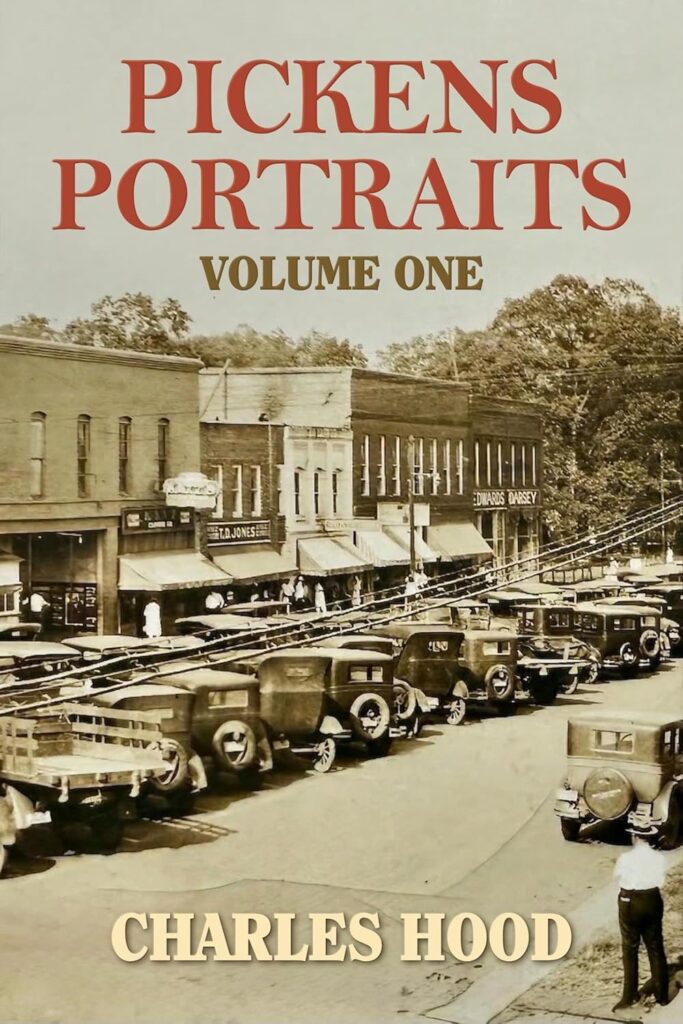
Author Charles Hood, whose well received book Looking for Space: My Pickens Journey, published last August, has so far raised about $6,500 for the scholarship fund for the Young Appalachian Musicians camp, has released a new book, Pickens Portraits, Volume One, which also is certain to receive favorable reactions in Pickens County and also will raise money for the scholarship fund named in memory of his youngest son, Ryan.
As with his earlier book, this new work is for sale through Amazon, available in paperback and on Kindle. Following is the description of Pickens Portraits, Volume One on the Amazon website: “Pickens, South Carolina. A small town at the foot of the Blue Ridge Mountains, with a history far greater and more fascinating than its size might suggest. In this volume, the first in a series, Charles Hood brings that history to life through stories of a beloved minister, a church in crisis, schools and cemeteries, country doctors, a terrible tornado, the coming of Lakes Keowee and Jocassee, the timber industry, the postal service, hometown athletic heroes, a musical idol, a bygone teen institution, and even a modern-day Daniel Boone. Along the way, he also captures the lives of ordinary townsfolk, whose everyday labors, hardships, and celebrations shaped the character of the community as surely as its better-known figures and events. Rooted in archival research, photographs, newspapers, and local memory, this book offers a richly textured portrait of a community shaped by hardship, change, and enduring pride. All royalties are donated to support Young Appalachian Musicians, ensuring that the proceeds stay local and help sustain the region’s living cultural traditions.”
In an interview with The Pickens County Chronicle, the author said, “When I wrote my memoir, Looking for Space, I didn’t anticipate the reaction. I just thought I was going to add a little interesting book, and maybe it will sell a few. But I wrote it really because I felt a few people I thought would be interested in reading it would like that nostalgic look back at how Pickens helped to shape who I was and what kind of town it was, back when the textile mills were all humming and downtown was busy. I was really taken by surprise with the reaction, with the appeal the book has had. It’s been overwhelmingly positive. In my book, I wrote about my own story, but I broke it up with these little chapters about little pieces of history, like the highways and Andrew Pickens and forgotten places. In speaking with residents during my book presentations, several of them said, ‘Would you be interested in writing a comprehensive history of Pickens County?’ I was certainly gratified that people asked me to do that, but, to me, that was a little bit too ambitious, and what interests me about history is the individual stories. It’s got to have a human story. It’s got to be at the human level. I want to write stuff that people are interested in reading, not a reference book. So, I decided to take the same approach to the little interlude stories that I wrote for my own memoir and tell myself – what are some people, places, and events that Pickens folks would be interested in reading about? So, I picked out a few figures that I thought would be interesting.
“I’ve got very detailed profiles on two sports heroes.” One of those sports heroes he features is the late Rudy Hayes, a Pickens native and outstanding football player for the Pickens High School Blue Flame, the Clemson Tigers, and the Pittsburgh Steelers. “I interviewed his widow (Nell Hayes),” Hood said. “I interviewed his children (Teresa Hayes Landers, Linda Hayes Constance, and David Hayes). “David was my classmate,” Hood said. The Hayes family, he added, lived close to where Hood lived when he was growing up in Pickens.
“I decided I needed a female sports figure,” he said. Someone suggested that he write about Peggy Anthony, outstanding volleyball coach at Pickens High School before her retirement, the 12th winningest volleyball high school coach of all time, and for whom the Pickens High School gymnasium is named. “I met her at a book signing, and I told her, ‘I think I might want to write a biography about you for the next chapter. I think it would be really inspiring.’ And, so, she and I collaborated.”
Hood also wrote a chapter about the late Dr. Lloyd Batson, a well respected Pastor in Pickens. “He was someone I really looked up to, as a kid, and he was a towering figure in Pickens. I enlisted the help of his son, Ellis.”
Another person Hood features in his new book is the late Browning Bryant, a Pickens native and singer-songwriter who first gained national attention at the age of 10. “I wrote about Browning Bryant, a former teen idol and musician who hit the big time, and that was a very interesting thing to write about,” Hood said. “I spoke with many of his old friends. I did some pretty detailed research on that.”
Another figure Hood wrote about was the late Dennis Chastain, whom Hood had planned to interview before Chastain passed away unexpectedly. “I was about to set up an interview with him through a mutual friend, Wayne Kelley, and, then, he got word that he had died in his sleep. I didn’t want to impose myself on his widow during her bereavement period, so I just left it alone. But she contacted me, and I guess she found that I would be interested in doing that, and she said, ‘I would love for you to come over and talk with me, and you can look through Dennis’ things and get some pictures and get some idea of what he was working on.’ So, she and I ended up collaborating, and that was one of the last chapters that I wrote. And it turned out to be a really very interesting piece about the many things that he did — not just history but also preservation and education.
“One of the interesting things that occurred to me during writing this book is how somebody who appeared in one chapter would show up in another. For example, I wrote about Rudy Hayes. And in 1959, after the Sugar Bowl, when he was a senior in college, Pickens declared Rudy Hayes Day. They had a big banquet for him at the high school, and I think Coach Howard was there from the Clemson Tigers. Everybody was there. And the preacher that gave the opening prayer was Dr. Batson.
“Dennis Chastain’s name appears, of course, in his own chapter, but, also, I wrote about Highway 11 — how did the scenic Highway 11 come into being, why is the Pickens section still relatively undeveloped and preserved, whereas, if you go into neighboring counties, it’s a lot less attractive? And Dennis Chastain was one of the key figures in helping keep it that way.
“Dr. David Peek was another very important figure. One of the chapters I wrote — because I’m a physician, I think, maybe I was interested in researching it — is how did the old country doctors practice at the turn of the 20th century? So, I profiled Dr. John Valley of Pickens and Dr. David Peek of Six Mile, and that turned out to be a very interesting journey. But Dr. Peek also shows up in the chapter I wrote about the 1929 Six Mile tornado that killed nine family members. Of course, he was pivotal in saving the lives of several people, especially the three-year-old girl who had a two by four impaled in her abdomen. Somehow, he miraculously saved her life, and this was before antibiotics. She grew up and lived a long life.
“What’s interesting is how people kind of move in and out of different chapters, which tells you that everything is all kind of connected. That’s what I find really fascinating about this — the more I read about it, the more I dig, the more connections I discover. The emphasis is always on trying to tell an interesting story.”
Hood interviewed Charles Dalton, a Pickens native who now lives in Greenville and who served as President and CEO of Blue Ridge Electric Cooperative from 1982 until his retirement in January of 2018. Hood said that, as he walked into Dalton’s home, he saw, among the items filling the walls, a photograph of Dalton shaking hands with Elvis Presley. “So, that led to a story, which I lead off with,” Hood said.
“Then, he took me into a garage with a room up above it, and the room above it is basically a recreation of the Pickens Donut Shop. He’s got the original signage. He’s got a juke box that works, a pinball machine from that era, a milkshake maker, a radio. He’s got the red and white checkerboard linoleum tile on the floor. It looks like you’re back in the ‘50’s.” Hood wrote about the Donut Shop in his new book. “No one who was born after 1970 would even know it existed, because it was already closed,” he said, “but, back in the ‘50’s and ‘60’s, it was the teenage hangout.” Hood added about Dalton’s garage, “He’s got all sorts of other important signage from Pickens that he has procured and then restored, like the old Rexall signs and the Texaco. It’s pretty amazing.”
Hood also interviewed June and Connie Bowers. “I thought maybe they could point me in the right direction for some things interesting to write about,” Hood said. “This was very early on, when I was trying to figure out what I wanted to write about. We ended up sitting on their screened porch, talking about each of their lives, and I realized these folks are really interesting. They each have individual and joint contributions to Pickens that were significant. So, that’s when I decided to feature some people that led, I think, exemplary lives, and I think people are interested in reading about those kinds of things, as long as the writing is interesting.
“It was actually Connie that led me to Charles, because Connie was Charles’ Chief Financial Officer for Blue Ridge for a number of years. And Charles’ son, Chad, is the Chair of the POSAM board that I’m on. And Connie’s son, Joey, is also on the board. It’s all kind of connected.
“I also interviewed Tubby Dodson. She ran the Feed Room back in the day. Her daughter, Martha, is a real close friend of Peggy Anthony’s. She was a big fan of my first book, and I went over to see her, and, then, her Mom came in and started talking about growing up in Pickens in the ‘40’s and how incredible it was to have electricity and running water and things like that, and I thought, “This is worthwhile. This is fascinating.’
“I think it’s important to highlight people in the community that have done stuff and quietly gone about their way to enhance the community or to leave a mark.” It is interesting, he said, to have the opportunity to visit with such people. “I go to their house, and we sit down and drink tea and talk about their lives,” he said. “And that often leads to other little leads for other stories.
“I’m hoping to find some people who have really interesting stories, regular folks that I can write about, for the next volume, as well.”
Hood said that he wanted to thank those who assisted him with research while he was writing his second book. “There are some people I would like to specifically mention,” he said. “There are people that I call amateur historians, people like me, but these are people who may spend hours and hours in the library, accumulating old newspaper articles and old documents that they have found on a particular subject, and then they go into notebooks or scrapbooks, and, then, when they pass away, there they are, all that work, and there’s really nothing that’s become of them to make them publicly known.
“Stanley Aultman was one such person who did tremendous research on all sorts of things related to Pickens. I was fortunate that his daughter, Suzanne, gave me access to his digitized scrapbooks. So, I am actually using them for not just this first book but the second book. One of the chapters that I wrote in this first book is about the Appalachian Lumber Company. And he had an incredible chronicle of all the important newspaper articles, documents, legal proceedings, even some old photographs. So, I want to make sure that Stanley Aultman is credited.”
Another person, Hood said, he would like to thank is Jerry Hughes. “He spends most of his afternoons at the Pickens library, researching all sorts of things, and his expertise is in reassembling what the town looked like, block by block, decade by decade. He has detailed maps for 1900, 1910, 1920, and so on. So, he was the go-to guy if I needed to know where something was located at a certain time, if I needed to verify that.”
Another person who helped Hood with research, he said, is Martha Hannah, who loaned him scrapbooks of research by her late mother. “Her Mom, Blanche Hannah, also kept tremendous notebooks, and her notebooks were helpful,” he said.
Another person he also wanted to thank is Kathy Payne Barnett. “Her Dad, Bill Payne, was The Pickens Sentinel photographer for years,” Hood said. “She gave me his old negatives. So, I’ve been busy digitizing them. And many of them do appear in this book, and they’ve probably never been seen before.
“John Cook is someone else that’s a big help. He’s a volunteer at the Clayton Room at Southern Wesleyan University. One of the chapters I’m working on is about the old Pickens hotel industry, which is very interesting, because, before air conditioning and before mosquito control, people who were well to do were coming up from the low country every summer to get away from the malaria and yellow fever and also the hot and sticky conditions. And they sought refuge in the mountains. Pickens was pretty close to the mountains. I think most of them went to Brevard and Hendersonville and Asheville, but we had hotels, and I wrote about those. John dug up all sorts of interesting old documents that I was able to use to buttress those chapters with a lot of interesting details. So, a definite shout out to him.”
Another person Hood said he wanted to thank is Jo Ann Gilstrap Brewer, administrator for the Pickens (SC) History THEN AND NOW Facebook page. “If I have a question — Does anyone have information about such and such — I post it and almost always get some helpful response or a contact person, somebody I could call and ask a question. So, it was kind of a community effort, also.”
Another person he wanted to thank is the late Dennis Chastain’s wife, Jane Chastain, whom he previously mentioned. “She gave me full access to his material,” he said.
“And I’ve got to mention Barry Crawford, because Barry has been super,” he said. “He let me see all of his treasures and take pictures, and he would explain how he acquired some of these things. He gave me a lot of insight on the chapter I wrote about saving the water tower, because I know he was one of the most outspoken proponents for making sure we didn’t tear it down. And he’s got a lot of other input, as well, on the chapter about Dr. Valley. He’s got lots of Dr. Valley’s old equipment, and he even refinished one of his old medicine cabinets. And he’s got sports memorabilia. He’s got coinage. He’s got postcards. He’s got a whole museum. He was super helpful.”
Hood said that his new book, Pickens Portraits, fills a void. “I think the last really important book of the Upstate was probably Red Hills and Cotton back in the ‘40’s, with Ben Robertson’s memoir. There’s not a whole lot from people my age, the Baby Boomers, about growing up in the ‘50’s, ‘60’s, ‘70’s, ‘80’s, even later, and a lot of things have transpired with modernization — for example, school centralization, the building of the Keowee Toxaway Project, the modern highway system. There’s so much material. That’s the thing. It’s amazing, how small the town is, there is so much history in the whole county, I should say.
“And here’s an interesting little story,” he added. “The Pickens Graded School, the original school building on Cedar Rock Street, stood for about 68 years before it was demolished. I talked to a lot of people that actually went to school there, and I was able to put together a real detailed kind of remembrance of that, as well as the cemetery right down the street. Sunrise Cemetery has an interesting history of its own.”
Betty Dalton, who was his seventh grade teacher and whom he profiled in his book Looking for Space: My Pickens Journey, told him that he needed to write about the stain glassed windows at Grace United Methodist Church. He found out that the prior church building had burned down in 1945. “It was rebuilt by a comprehensive community effort,” he said, “and it was dedicated in 1949, and these beautiful stain glassed windows were put in, and they all have dedications. There are 12 of them. I took a tour with one of the church congregants and historians, Michael Johnson, and he pointed out all the windows, and I did a lot of research on each of them. So, the chapter about Grace is about the fire, how they rebuilt after the fire, and how important these 12 stain glassed windows are. I don’t think many people in Pickens know what kind of treasures those are.
“One of the things that I learned from writing the chapter about Grace, which includes a history of the church, was that, in the late 1800’s, they were running out of space to bury people. Their burial place was basically where people park now. There’s a little fenced-in playground in the parking lot behind the church, where there’s some slides and swings and things, a little play area — that’s where the old cemetery was. Colonel Hagood, who figures in a lot of Pickens history, and his wife donated an acre of land on Cedar Rock, which is where the original Sunrise Cemetery came about, and they disinterred all of the graves behind the church and moved them all to this new place. He insisted that it was not going to be just for Methodist folks who had passed away but the entire town. It was the first town cemetery. And the interesting story about that is that it grew into three parts. There’s the Grace section, and then there’s the section to the east of that, which became the Pickens Cotton Mill burial grounds, and then there’s a section at the bottom of the hill along Railroad Street, which became the paupers’ gravesites. If you look down the hill, you see very few elaborate markers. In fact, there’s a lot of flat land there. And, so, you have these three constituencies, and they’re all together in one graveyard, with this beautiful view of the Blue Ridge Mountains. It’s an interesting story.”
Hood spoke of Decoration Day (which is now called Memorial Day), when students from the Pickens Graded School would walk to Sunrise Cemetery. “The children at the Pickens Graded School would all be told on Decoration Day to bring in flowers or even branches, just some type of plant material, to lay on the graves of soldiers. They would all march over and be led in prayer and leave their little memorials and walk back to school — just kind of an interesting piece of old history. I actually talked to a couple of people that are still alive that did it, one of whom was Tubby. Tubby remembered that well.”
He spoke about a well known teacher, the late Olive Boggs Newton. “She taught at Pickens for many, many years. “She was famous for holding her students to a strict standard of personal hygiene, by making sure they had a clean handkerchief with them every day, and she would inspect their hands and fingernails every morning for any grubbiness. I have a picture of her. She was an interesting person. She also was a writer. She did a little bit of Pickens history.”
Hood said that he wrote so much history that he decided to write another volume. “I actually wrote more chapters than are in this book, so there are actually four chapters that wouldn’t fit, because I was basically maxed out on page count. It’s already 675 pages long. A lot of it is pictures and maps, but there are a lot of words, too. So, that’s why I call it Volume One, because I’ve already got the material. I don’t have it all written, but I have the material picked out for the sequel.”
Hood said that, among the chapters he has written for the next Pickens Portraits book is a chapter on the late Larry Hinkle, whom he called “the world’s best Jeep salesman.”
He has much more in store for the second Pickens Portraits book, also. “I also wrote about the Pickens centennial,” he said. “I wrote about Dr. Julius Scipio. I’ve got a chapter about the Pickens jail. I’ve got a two-part chapter about the Doodle. I’ve got about half of the material for another book, but I probably won’t finish that until next winter.
“I want to write about David Stone. His wife taught me. He’s on my list for the next book.”
He spoke of Bivens Hardware Store in downtown Pickens. I need to write about the Bivens story in Pickens, because it was big, businesswise, that’s for sure.”
He also spoke of Brock’s Department Store. “I believe that the daughter, Cathy, still runs the store.”
Hood also plans to write a chapter in his next book about the Appalachian Railroad. The day after this interview, he planned to meet with Alan Warner, miller at the Hagood Mill Historic Site. “He is kind of like the expert on the Pickens Railroad. He and I are going to retrace the old path of the Appalachian Lumber Eastatoee Railroad.
“I think the next person I want to talk to is the Mayor of Pickens, Isaiah Scipio. I’ve already written about his Dad, but I want the inside story from his family, and I want his story to be one of the features in the second volume.
“Hopefully, this book will be well received. If it is, I will definitely finish the second one. And, who knows, maybe there will be a third one.
Hood said that his goal is to sell 2,000 copies of Pickens Portraits, Volume One and raise $10,000 for the scholarship fund for the Young Appalachian Musicians. Looking for Space: My Pickens Journey has sold 1,350 copies, and the $5 royalty per book equates to about $6,500 for the YAMS. Hood said that he hopes to sell more copies of Pickens Portraits. “I think this book will have a broader appeal, because it’s not about me,” he said. “There’s something in there for everybody.
If all of Coach Peggy Anthony’s former volleyball players were to buy a copy, he said, “that’s probably hundreds of copies right there.”
Hood is scheduled to speak, about his new book, at the Pickens Village Library at 4:30 p.m. on May 27, and he plans to speak in April at the Pickens Senior Center. “Russ Gant contacted me and said, ‘You need to come to the Senior Center, because it’s free, and there are a lot of people that will be interested. Mostly seniors are going to be interested in this kind of stuff, so, I’m hoping to set something up with them sometime in April.”
Hood said that he felt compelled to complete Pickens Portraits as quickly as he could. “Part of it is because so many of my sources are over age 85. Many people I’ve talked to are in the fourth quarter of life. So, I felt compelled, especially after Dennis suddenly died and Anne Sheriff passed away last year. I felt I don’t need to be wasting time. I want some of these people to actually see their stories and their contributions and read about it while they’re still around.
“I think that I’m proudest of the fact that I feel the previous book and, hopefully, this book will kind of spark more interest, especially in joining the Pickens County Historical Society. I make an appeal to that in my preface. It’s a good organization. They’ve got good projects. They have regular speakers that are interesting. And we need a new generation of people beyond the Baby Boomers to come in and keep it going.”
Referring to his two books so far about the history of Pickens, he said, “It’s been fun. I’m enjoying the ride. I’m enjoying it as long as it lasts and as long as there’s interest.”