
Memories of Yesteryear...
Born to be a preacher: The life of Julius Scipio
By Karen Brewer
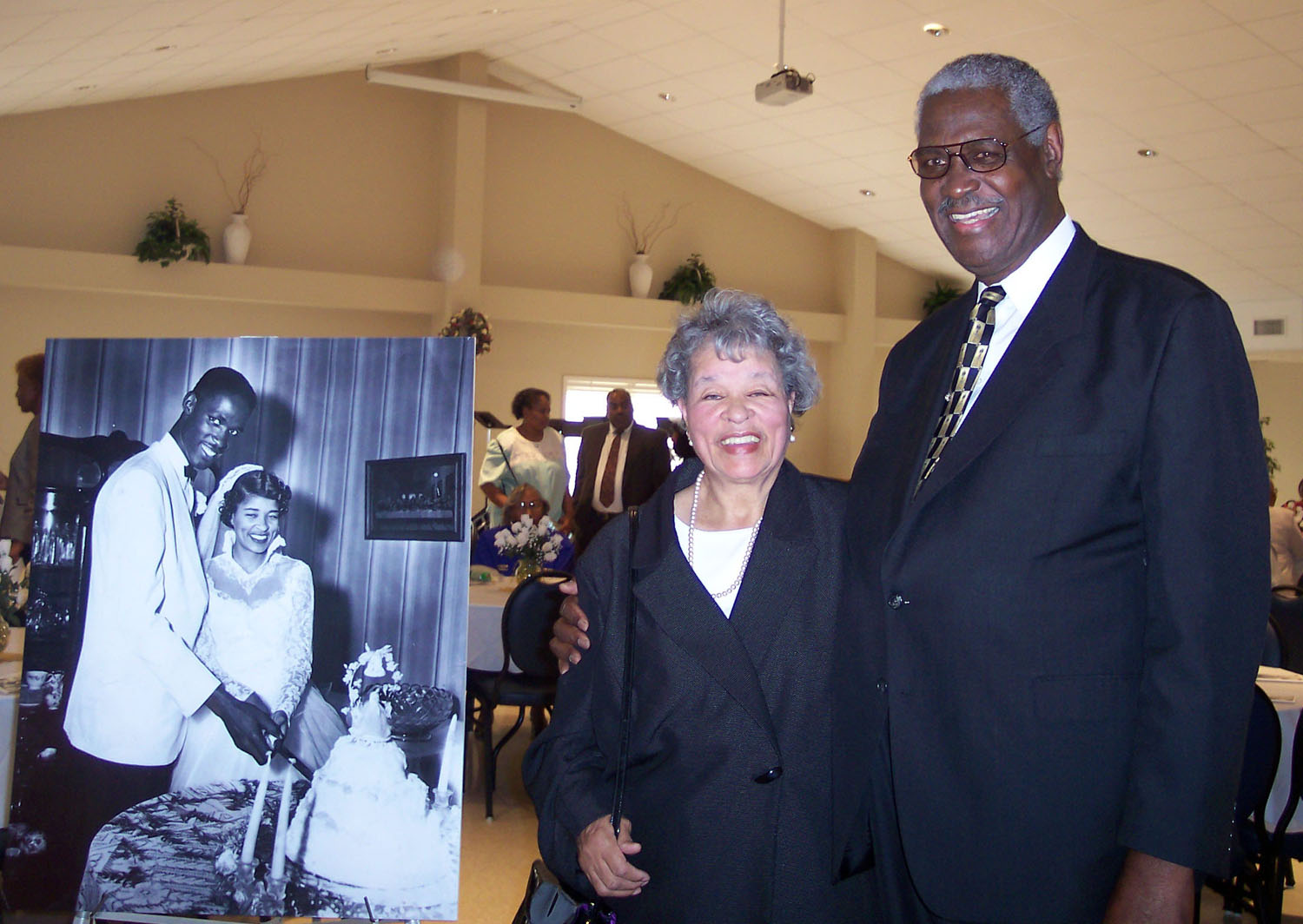
Julius and Linda Scipio at their 50th wedding anniversary celebration (held at Secona Baptist Church in Pickens on June 5, 2004) pose by a photograph taken on their wedding day in 1954. (Photo by Karen Brewer)
“Do you see that smile on her face? I put it there.”
Dr. Julius Scipio had a smile of his own for his wife, Linda, on their 50th wedding anniversary. Family and friends were invited to Secona Baptist Church’s fellowship building for a special reception in their honor on Saturday, June 5, 2004. The two were married on June 5, 1954 at Robinson Chapel United Methodist Church in Liberty.
“It doesn’t seem like 50 years,” Scipio told this writer. “It has been such a beautiful ride with so few bumps in the road that we don’t realize we’ve traveled so far.
“My wife and I have always had a powerful relationship. When we were married, we took a vow that we wouldn’t allow gossip from any source to affect us in any way, and that we would never go to bed angry with each other. We’ve always measured our words when we’ve gotten upset about something. We wouldn’t want to do anything we would regret. If we had problems we couldn’t solve, we wanted to be sane enough to be able to say that we can’t solve this tonight, but we could kiss and go to bed and know that, in the bright light of a new day, it would probably look much better. What people disagree about usually isn’t that important. It’s a matter of who’s going to have their way. We took a vow the night we were married, and we had prayer and decided to take these additional vows. We are in it for the long haul. People say marriage is so hard, but it’s really not hard, if you have the right mindset and the right person.
“For the past 30 years, I’ve gotten up every morning and gone to McDonald’s to get her coffee, because she likes McDonald’s coffee. And if she wants breakfast in bed, I fix breakfast. When people are courting, they usually do those kinds of things, but, when they get married, they figure they have it made. But, if it takes that to get them, it takes that to cultivate a rich relationship.”
The Scipios met in 1947 while he was a student at Clafflin College in Orangeburg and she had transferred from Clark College to South Carolina State College. It was love at first sight.
“I prayed for her,” he said. “I share this with young people. Marriage is such an awesome step that I don’t think there is any human sense that we can draw from to give us the kind of assurance we need in choosing a mate. I believe that God has to intervene. For three years, I prayed for God to give me a wife, a preacher’s wife.”
Scipio knew all of his life that he would follow in the footsteps of his paternal grandfather (for whom he was named), in being a minister. “When I was five years of age, my Dad could not put me in a field behind a mule without my tie,” he said. “My tie would drag the ground.”
His maternal grandfather was also a minister, but he died in 1922, six years before Scipio was born in Darlington.
“I knew my father’s father very well,” he said. “He was a local minister, but he had had a stroke. He lived a mile from us, and, every Wednesday, he would walk a mile and bring us a bag of pecans. He would have a stick in one hand, walk on one leg and drag the other one, because he had had a stroke. He would say, ‘You are my little preacher. I want you to pass these pecans around to the boys and girls. I know you are going to be fair.’
“I just felt a strong urge to be a preacher like him. From the time I was five years old, I felt I was drawn to the ministry.
“He named me. He said, ‘You have my name. You are going to preach all over the world.’ Here was a man who could not read or write. He was a slave, born in 1842. He had a memory ‘like an elephant.’ He was an effective preacher in our area. He said, ‘I’m not going to be around, but you’re going to travel, and you’re going to preach all over the world. I feel like I’ll be there, too, because you have my name.’
“There were times, when money was slow, when I would feel the need to back away and do something else. I had a teaching certificate, and I said to my wife one day, ‘I think I’m going to back away from it for awhile and get a schoolteacher’s job.’ She said, ‘No, honey, we’re going to make it.’ I hadn’t wanted to (back away from it), but I really was feeling her out. She was never materialistic. She had friends who were living large and driving big cars. I would say, ‘Honey, I’m sorry I can’t give you that lifestyle.’ She would say, ‘I wouldn’t want it.’ It goes back to the fact that ‘life does not consist in the abundance of things.’”
The first church Scipio pastored was in Bennettsville. “I had just graduated from college, and, that following fall, I taught social studies for a year at St. John High School in Cameron. Then, I went to Howard University for a year. My Dad took sick, and I came home to take over the farm. My baby brother was in high school. Had I not come home, he would have had to come out of school. I came home for three years to go to the farm. My baby brother finished school and went to college.
“I pastored that first church in Bennettsville. I went there in 1951 and stayed there until 1953 and came here. I pastored here until 1956, when I finished at seminary.” In Pickens County, at that time, he had a four-point circuit, four churches he pastored: Pickens Chapel Methodist Church, Robinson Chapel United Methodist Church, Cross Roads, and Union Campground. “I was driving 300 miles every weekend between here and Atlanta and back,” he said. “And I was taking 16 hours of graduate work at the same time.” He graduated in 1956. When his senior sermon was recorded, his daughter, Danee, born in 1955, cried as his wife held her on her lap. “Her cries came out on my senior sermon,” he said.
After seminary, he and his family traveled with migrant workers, for whom he served as a chaplain. “We were stationed in Pompano Beach, Florida, and we traveled with the workers along the eastern seaboard all of the way to Rhode Island,” he said. “In November, we would head back to Florida again. We did that twice and then were permanently stationed in Pompano Beach, Florida. We were there five or six years, and then went to St. Louis, Missouri, where I pastored a church from 1961 to 1966. “We were there to see the Arch completed. Our oldest children’s names are in a time capsule in the base of that Arch, along with all of the other school children’s names.
“We went to Detroit, and we were there during the worst riot in this country, with the exception of the one in Watts. More than 60 people were killed in the streets of Detroit in 1967. It was a local thing, nothing on the national scene until Martin Luther King was shot, and people burned down a lot of stuff. To me, that was so foolish, because he gave his life for peace. People just went crazy.
“We came back in 1970. That’s when Larry, our baby boy, was born.”
Scipio assisted his mother-in-law, Floy McDonald, with her nursing home. She had been a midwife who delivered more than 500 babies and had built three nursing homes, including Rosemond Nursing Home in Pickens. “She was the biggest employer in the black community,” Scipio said. “She learned to read and write after my wife learned to read and write. If a person wants to do a thing, they will find a way. If they don’t want to do a thing, they will find an excuse. There were no excuses in my mother-in-law’s vocabulary. She had the tenacity of a bulldog. If she set her mind to it, you could rest assured it was going to happen. She’d find a way to make it happen.”
In 1973, Scipio was called to a 10-member church in Spartanburg. “I came from a 2,000-member church to a 10-member church,” he said. “They were in a ragged building behind Wofford College. We bought a new building that cost about $160,000 – with 10 members. We took in about 60 members that first month. It went up and up. People started coming, and to pay for that church was no problem at all. But it took faith to move those 10 members into that $160,000 church, with four acres of land. I stayed there from 1973 to 1982, the longest I stayed at a church.
“Then, I went to Columbia, to a big church downtown, and stayed there until 1987, when I went to a 1,000-member church in Memphis. I stayed there until 1991. That’s when I came home. I had been in evangelism ever since until October, 2003, when I was called to be the interim Pastor at Royal Baptist Church in Anderson.” (In June, Scipio was called as Pastor of Royal Baptist.)
“When my wife and I went to this church, the first Sunday in October, I said, ‘You can find preachers who can beat me preaching. But I promise you this: You will never find another preacher who will love you the way I love you. It’s unconditional love.’ My mother said this when we were growing up: ‘You can talk about me as much as you please, but, when I talk about you, I’m going to be on my knees.’
“There’s nothing anyone can do to me to change who I am. I would never allow folks to make me act in a certain way and take me out of who I am. I think I ought to be that in spite of what happens.
“Being a Christian is like homogenized milk. The mind and body are so intertwined that you can’t separate them. Christianity is that way; it should be so much a part of my life that it affects the way I talk, the way I walk, the way I relate to people. I shouldn’t have to walk around and say I’m a Christian. If you treat people as a Christian ought, they will say, ‘There’s something peculiar about that person.’ The song goes, ‘How shall we know we are Christians? By our love.’
“Better than any accolade I could ever have is that children feel comfortable around me,” he said. “Kids are not safe at home anymore. Everybody ought to have a safe place.
“My wife and I were watching a movie one night. It showed a man beating his wife. He was so brutal to her. She finally broke away and had to go to a shelter for battered women. We went on to bed that night, and, about 3:00 in the morning, my wife said, ‘Julius, are you asleep?’ I said, ‘No.’ She said, ‘I just want you to know that I feel so safe with you.’ She has told me some beautiful things, but that’s the greatest compliment she ever gave me — to know that she’s safe in my presence. South Carolina leads the nation in battered women. We would never want to put that in the top priority. I preach to our young people: let’s not add to this negative publicity; be kind to people.’”
Scipio said that a joy of his ministry has been to “hear young people whose lives I’ve been able to touch years later come back and say, ‘I am what I am because I got a chance to meet you.’ I was able to multiply my life through the lives of young people.”
He related a story about a young woman he had watched grow up in the youth group of the church he had pastored in Memphis. “She was a brilliant kid, had such promise,” he said. Her father had bought rare coins with his money, and, when she had graduated from high school, he said that he did not plan to send her to college. Scipio asked her father for his permission to send her to school. He then told her, “Start packing your bags. This fall, you will go to college.”
“I didn’t a bit more know what I was going to do, but it just came out,” he said.
He was able to secure scholarship funds as well as money from the church to pay for her college education. She has since earned her master’s degree and has finished her dissertation for her doctorate. “She ran for the Mississippi State Senate this past year and garnered 40% of the vote, for the first time ever going into politics,” he said. She sent him a letter in which she wrote, “Reverend, I want you to know I am what I am because of you. You made that possible.’
“Nobody knows what a gentle touch can do to steer people to their destiny.
“I just cried,” he said.
“I can multiply this in many ways where we were able to do things for young people. The highest moment of my life is when I’ve been able to see the fruit of our labor manifested in their lives. I think that’s really what eternity is about. You put yourself in the life of a child, and they, in turn, put that in another child’s life. You keep living. So, it’s not how much you acquire, how much money you have. God is faithful, and He rewards faithfulness.”
The Scipios were blessed with five children of their own: Danee Bowens, of Pickens; Julius Edward ‘Eddie’, of Warner-Robins, Georgia; Isaiah (who was named for his paternal grandfather and who followed in his father’s footsteps as a preacher), of Pickens; John, of Alpharetta, Georgia; and the late Francis Lawrence ‘Larry’. The Scipios are also proud grandparents of eight grandchildren and three great grandchildren.
Their youngest son, Larry, died three days before Christmas in 1980 at the age of 10. He had been diagnosed with leukemia at the age of eight.
“He had a bone marrow transplant at Johns Hopkins,” Scipio said. “My wife and I stayed with him. That was another real trial. She went there and stayed until he died. We went there the early part of October and she was there through December. I was pastoring in Spartanburg. I would stay at Johns Hopkins through the week and would leave about 12:00 Saturday. At 1:00 Sunday morning, I would be in Charlotte, North Carolina. I’d put up for the night and drive the next morning to Spartanburg for Sunday school, and I’d preach. The ladies would fix my food in a shoebox, and I’d set it on the seat of the car and turn around and drive back to Johns Hopkins. I would get in there at midnight and relieve them. They would have been in the hospital all weekend.
“My oldest son gave my youngest son the bone marrow. I have a sister, Laura, who is a registered nurse living in New York. When it happened, she left Brooklyn and was by our side as a registered nurse. She stayed there until he died and came to Pickens for the funeral. That’s the kind of relationship that keeps people going.
“Our family has 10 children, and we all have that kind of relationship. If one hurts, the other nine feel the pain. I can’t wrap my mind around it when I see families fighting and feuding. We’ve never had that. Mom and Dad told us early on, ‘If you love one another, no one on the outside is going to try to destroy you. Have a close-knit relationship.’ That’s the thing we’ve kept alive all of these years.
“Would you believe there are 10 children in our family, and all of us are still living? The median age is 75. Our baby sister is 65. My older sister is 85. All of us are still living. That’s a miracle.”
The Scipios decided to celebrate their 50th anniversary at Secona Baptist Church, because their son Larry is buried there. “We felt the closeness of our baby boy,” said Scipio.
Scipio spoke about the closeness of their youngest son to two of his classmates, twins Brett and Bart Turner, members of Secona Baptist Church. “Larry would spend the night at their house, and they would spend the night here,” he said. “My son would say, ‘Do you know why I love the Turner boys? Because they don’t treat me like I’m sick. They treat me normal.’
“They were pallbearers at his funeral, along with his brothers. They were close. They were all 10 years of age and in the fifth grade.
“It was the first integrated funeral in Pickens. He had attended Pickens Elementary and then transferred to Hagood Elementary and was there about a month. Busloads of kids were brought to the funeral. White girls and black girls were flower bearers. White boys and black boys served as pallbearers. I thought about what Dr. Martin Luther King had said, about little black boys and little white boys holding hands together.”
Brett Turner, who is now the Head Football Coach at Pickens High School, spoke at the Scipios’ 50th wedding anniversary reception. “Brett talked about how close he and Larry were,” said Scipio. “He said, ‘Larry affected my life in such a wonderful way, that I discovered, when my child came, Larry had prepared me for that.’
“Dr. Lloyd Batson has always been an integral part of our lives, during good times and bad,” Scipio continued. “He invited me to preach at First Baptist in the early 1970’s, at a time when this wasn’t popular. I went on a Sunday morning, to preach at First Baptist, and the place was packed. The Holy Spirit fell on that congregation. It was just awesome.
“He was with us when Larry passed. I’ll long remember his remarks. It was right at Christmas. He said, ‘When the wise men came to see Jesus, they were led by His star, but, when they got to Bethlehem and they found the Christ child, the star disappeared.’ He asked the question: ‘What happens when the star is gone?’ That man waxed eloquently. He said, ‘When the star is gone, we all have a holy presence once we come in contact with Christ.’
“To lose a son, a baby son, I’ve seen it ‘kill’ a lot of people. But, during the funeral, we were holding hands and comforting our people. It was a matter of the shepherd taking care of the sheep. They would say to me, ‘Reverend, you sit down. Let us take care of you.’ I said, ‘No, you’ll never see in the Bible where the sheep take care of the shepherd. It’s the shepherd’s job to comfort the sheep.’ And, from that experience, people say, ‘Reverend Scipio, I want to have a grip on life so that, when something like this happens in my life, I can be as firm and calm.’ We talk religion, but we’ve got to be able to live it. We’ve got to be able to mean what we say. This has been my sustaining strength and calm.”
In 1994, Scipio was recognized both locally and nationally with a Jefferson Award for Public Service for his work with The Elephant Men, which he founded. The Jefferson Awards, named for President Thomas Jefferson, were begun in 1972 when Jacqueline Kennedy Onassis, Senator Robert Taft, Jr., and Sam Beard founded the American Institute for Public Service as a way to award a ‘Nobel Prize’ for public and community service. Scipio received not only the Jacqueline Kennedy Onassis Award for Outstanding Public Service Benefitting the Local Community in 1994 (one of only five on the national level), but he also was named in the Jefferson Awards Hall of Fame, as one of the top 25 recipients, in 1997 (again one of only five), during the 25th anniversary of The Jefferson Awards.
“I said, ‘Do you mean to tell me they give awards to people for doing what they love to do?’ It was quite a surprise and a humbling experience.
“The Elephant Men was started for troubled young men who didn’t have a lot of support from home,” he said. “We would go to the courts. I noticed there were several kids being processed. They would send them down to Columbia, because there was no alternative. I started working with the judges to come up with an alternative to prison, and they were very cooperative. We were able to do some miraculous things with young people who were constantly in trouble, and get them on the right track. Our motto was ‘to protect and direct.’”
The name for the organization came from the fact that adult elephants in the wild will circle around a younger elephant to protect him.
“So many boys now in prison had no daddy around,” said Scipio. “To have a father is about a rarity now in a lot of families. The mother has to take on so much responsibility, getting two jobs to just put food on the table. Because of that, there may be no discipline in the home.
“The community rallied to our support and gave us funds. Right now, it’s not very active, because we just about worked ourselves out of business. We don’t have any young men in the prison system in the city of Pickens.”
Scipio accepted his award in the U.S. Supreme Court building in Washington, D.C. When he was selected as one of the ‘best of the best’ for the 25th anniversary of The Jefferson Awards, he and the others were each given time to speak, as the awards presentation was televised by C-SPAN from The Library of Congress. Scipio was told, “Think carefully about what you are about to say, because it will be heard around the world.”
“My sainted grandfather had said, ‘You’re going to be preaching all over the world,’” said Scipio. “I have never been abroad, but my voice has traveled abroad. My sainted grandfather could not read or write, and I thought, ‘How in the world could he have had this kind of vision?’ There, I stood and cried. I became overwhelmed with emotion. He said, ‘You will go all over the world, and I will be there with you.’
“People called me from Memphis, Philadelphia, California, New York. They had seen me on television. I thought, ‘Here I am, just a country boy.’
“From the time I was six to nine, I stuttered so badly, I couldn’t say a sentence. I would just shake, trying to get my words out. As I look back, it was a direct result of the death of my grandfather, whom I idolized. I couldn’t handle it. Dad would pray for me. Mom would pray, ‘Cut loose this boy’s stammering tongue. Let him be a spokesman for you, Lord.’ I had never been to a medical doctor, never been to a speech therapist. They didn’t have speech therapists then. I rest my case. I don’t stutter anymore. God answered their prayers.”
When speaking to groups, especially to students, Scipio often recites the following poem written by Dr. Benjamin E. Mays, President of Morehouse College in Atlanta from 1940 to 1967: “I have only just a minute. Only sixty seconds in it. Forced upon me, can’t refuse it. Didn’t seek it, didn’t choose it. But it’s up to me to use it. I must suffer if I lose it. Give account if I abuse it. Just a tiny little minute, but eternity is in it.”
“We knew him real well,” Scipio said of Mayes, a native South Carolinian from Ninety Six. “His father was a sharecropper on land where Lander College is now,” Scipio said. “He was a sharecropper, working with his father, on that same land. In 1973, they invited him to Lander College to speak, and they conferred upon him a Doctor of Letters. The next morning, the newspaper headline read: ‘From Sharecropper to Doctor on the same piece of land.’
“God has in store for us things that we can’t even perceive. If anybody had told me when I was a boy behind that mule that my life would take on the direction it has taken, I would never have believed it.”
Family and heritage are so important to the Scipio family. The home in which he and his wife live, where grandchildren play, is the same house in which she was born.
He, himself, came from a family of 10 siblings. “I was number five,” he said, “right in the middle. Out of 10 children, there were five boys and five girls. I’m the fifth child born on the fifth day of the fifth month. I got married the fifth of June. Our first child was born on the fifth of April. We had five children. So, five was my lucky number.”
Scipio said that he has always tried to be an example for his children, and that they never had to wonder about the importance their father placed on his family, no matter how busy he would be.
“Our baby son had written a letter, which said: ‘My Daddy is a preacher and has to be away a lot, but, when he’s home, he’s home.’ They never felt I had other stuff more important. My mother taught me that. We grew up on a farm. On Sunday, my mother would take out her best linen and cook dinner fit for a king and queen. We would say, ‘Mama, is company coming?’ She would say, ‘The greatest company I know — my family.’”
Even today, Scipio said, his children, who are grown with children of their own, give him cards.
“They always write, ‘Daddy, you’re my hero.’”
Publisher’s note: This story, written by Karen Brewer, was originally published in 2004.