
New book Looking for Space: My Pickens Journey pays tribute as a 'love letter' to Pickens and honors the memory of author's son through Young Appalachian Musicians (YAM) program: The Pickens County Chronicle interviews the author, Charles Hood
By Karen Brewer, Publisher & Editor, The Pickens County Chronicle
The Ryan Hood Memorial Scholarship Fund honors the memory of a young, talented guitarist by helping local students learn to play guitar, and, now, proceeds from a book written by Ryan’s father, Charles Hood, about his hometown of Pickens, will assist the scholarship fund with giving underprivileged students the opportunity to take guitar lessons in the Young Appalachian Musicians (YAM) camp.
Ryan, born in August of 1996, passed away in May of 2017 at the age of 20. “He was a really gifted guitar player,” his father said, during an interview with The Pickens County Chronicle. “He went to the Governor’s School for the Arts in Greenville and studied guitar. He was in college at U.S.C., studying jazz guitar, and he was part of a band.” Ryan first learned to play guitar in the fourth grade, when a retired gentleman with a collection of guitars visited Ryan’s elementary school and taught the students. “Ryan was immediately enamored with the whole thing,” Hood said. “By the time he was in the eighth or ninth grade, he was playing at such a high level.” Ryan’s brother, Michael, also became interested in playing guitar. “He is very good at it,” Hood said. “I’ve been teaching myself how to play over the last six years. I’m not nearly as good, but it’s fun.”
The Hood family created a lasting tribute in Ryan’s memory, with the assistance of Charles Hood’s former Pickens High School classmate Perry Gravely. “We decided to establish a scholarship fund in his name,” said Hood. “I contacted Betty McDaniel, and, with her help, we set up the Ryan Hood Memorial Guitar Scholarship. We pay for the tuition for summer camp for kids that are socioeconomically deprived in Pickens County, so that they can attend the one-week guitar school, where they learn how to play. And we also award two $500 scholarships to graduating YAM students, kids that are in high school that are leaving the program, so they can buy their own instruments.” Speaking of his son Ryan, Hood said, “He would be so thrilled that his name has some association with the Young Appalachian Musicians.”
Even though Hood and his wife, Anita, live on Lake Murray in Irmo, near Columbia, Hood has returned to Pickens with his family many times through the years, and they have a cabin in Pickens. Speaking of his son Ryan, Hood said, “He loved Pickens. He especially loved going up to Long Shoals Park and sliding down. We camped at Table Rock State Park several times. He loved hiking. I think he was like me. The woods, for him, were kind of his cathedral. He was happy when we came to Pickens.”
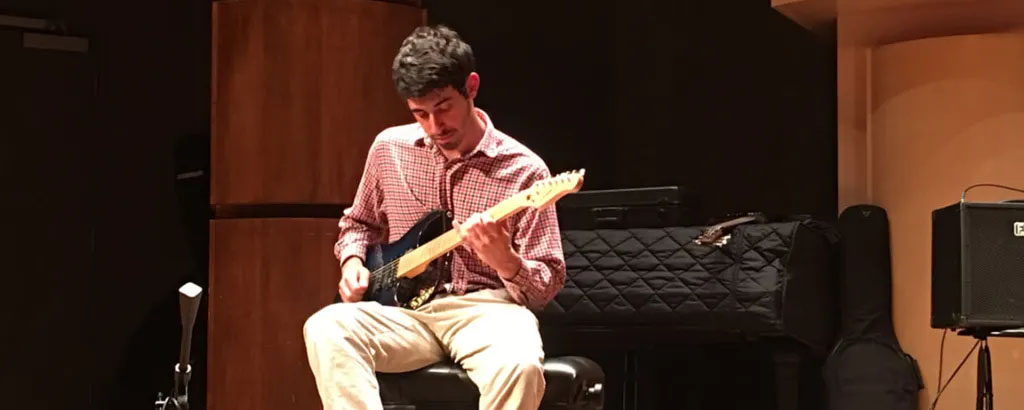
Ryan Hood
Charles Hood is always happy to come to Pickens and does so about twice a month, to their cabin. “I tell people, if you need your spirits lifted, you’ve got to go up and see the mountains. Just park your car on Main Street. It feels like a security blanket when I come home. It’s kind of comforting how little the downtown area has changed. It still has that small town feel.”
It’s a place that he calls home, a place he first called home in 1973 after moving to Pickens following the death of his father when he was 10. And, in his new book, he wanted to document and capture what it was like growing up in the small town during the 1970’s.
The title of Hood’s book, Looking for Space: My Pickens Journey, comes from the song “Looking for Space” (written and sung by the late singer, musician, and actor John Denver), released in 1975, when Charles Hood was a teenager growing up in Pickens. “Looking for Space” was the class song for the Pickens High School Class of 1979. (Eight years later, in 1987, Denver’s song would find a new generation when it was featured prominently in the Magnum P.I. episode “Limbo.”)
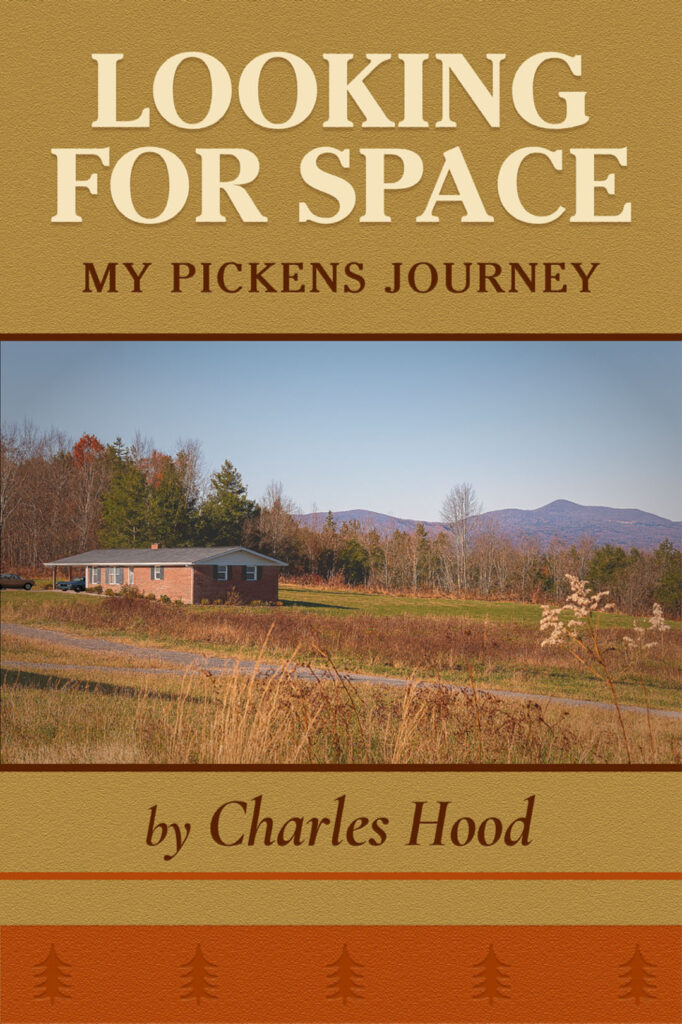
Book cover for Looking for Space: My Pickens Journey (Photo courtesy of Charles Hood)
Following are the lyrics to Denver’s song, “Looking for Space”:
“On the road of experience, I’m trying to find my own way,
Sometimes, I wish that I could fly away.
When I think that I’m moving, suddenly things stand still,
I’m afraid ‘cause I think they always will.
And I’m looking for space,
And to find out who I am,
And I’m looking to know and understand.
It’s a sweet, sweet dream;
Sometimes, I’m almost there.
Sometimes, I fly like an eagle,
And, sometimes, I’m deep in despair.
All alone in the universe, sometimes that’s how it seems,
I get lost in the sadness and the screams.
Then, I look in the center, suddenly everything’s clear,
I find myself in the sunshine and my dreams.
And I’m looking for space,
And to find out who I am,
And I’m looking to know and understand.
It’s a sweet, sweet dream;
Sometimes, I’m almost there.
Sometimes, I fly like an eagle,
And, sometimes, I’m deep in despair.
On the road of experience, join in the living day.
If there’s an answer, it’s just that it’s just that way.
When you’re looking for space,
And to find out who you are;
When you’re looking to try and reach the stars.
It’s a sweet, sweet, sweet dream;
Sometimes, I’m almost there.
Sometimes, I fly like an eagle,
And, sometimes, I’m deep in despair.
Sometimes, I fly like an eagle,
Like an eagle…
I go flying…
High…
Free…”
Looking for Space: My Pickens Journey tells the story of his growing up in Pickens after moving there at the age of 11. “It’s kind of like my love letter to Pickens, and I think it’s a story of redemption, because it starts off with a tragedy with the loss of my Dad, and it ends with my graduation from Pickens High School. In that seven-year period, I went from being 11 to 18, and I grew up a lot.
“Both of my folks grew up in West Virginia. I was born in Indiana in 1961, so I’m not a native. When I was 10 years old, my father passed away. I was the youngest of six kids. My Mom didn’t want to stay in Indiana after my Dad passed away. We ended up moving to Pickens, because my brother was a nuclear engineer, and, when he got out of the Navy in 1972, it just happened to coincide with the opening of the Oconee Nuclear Station. So, he left Charleston, where he was stationed, and he and his wife moved up to Pickens, to take this new job, and they ended up living in Northway Apartments.” After living in Pickens for about a year, Hood’s brother and sister-in-law thought that Pickens would be the perfect place for the rest of the family. “I moved there at the end of sixth grade,” Hood said, and he attended all of junior high school and high school in Pickens.
“I kept my ties with Pickens. I’ve never really cut ties with anybody. My best friends are from Pickens. There’s kind of a slight inferiority complex. It’s like Greenville’s always getting all the attention, and then there are other parts of the state, like Columbia and Myrtle Beach and Charleston. I thought I would like to write a book that extols all the great things about Pickens County, and, hopefully, when people read this book, they’ll have a greater sense of pride of the place where they grew up. I do tell my story. It is autobiographical. But it’s not a typical memoir. I’ve mixed in a lot of Pickens history that’s got nothing to do with me.”
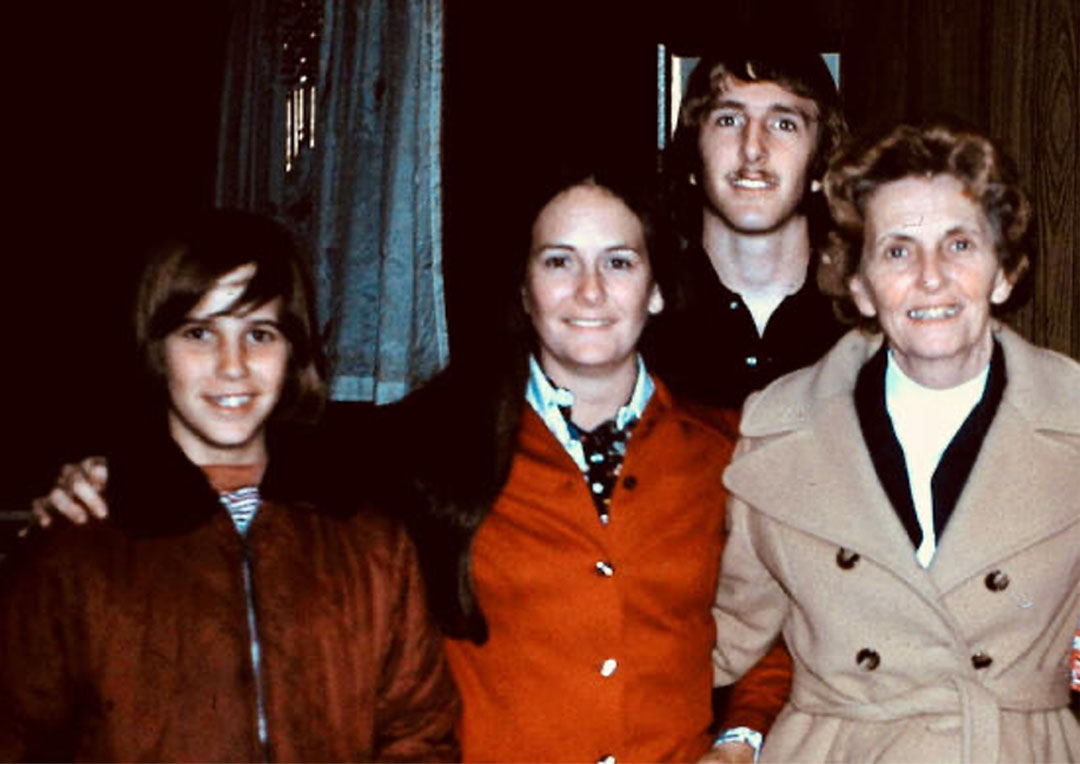
Charles Hood, at left, his sister, Mimi, and brother, Carroll, with their mother in 1974. (Photo courtesy of Charles Hood to The Pickens County Chronicle)
Hood recalls many adults from his youth who had served as role models for him. “There were so many people, adults who stepped up to set the right example for the kids like me,” he said. “And they were my neighbors, people I went to church with, my teachers, my coaches, my bosses. All these people had such a profound yet subtle influence on making sure I came out okay. And I think that was probably the magic of Pickens.”
One such person who had an influence on his youth is Betty Dalton, who was his seventh grade math teacher. “Mrs. Dalton is 90,” he said. “And, when she found out that I had written a chapter about her and how much she impacted me during my first year in Pickens, she somehow found out my phone number and contacted me. That was in April, and hardly a day goes by where she doesn’t call me. I can’t always pick up the phone, and she knows I can’t, because I’m at work. She leaves me all sorts of interesting messages – ‘You need to look up this’ or ‘I’ve been talking to’. She knows everybody. All these retired principals, assistant principals, other dignitaries around town, she would say, ‘You need to call Charles Hood.’ They would call me and say, ‘Mrs. Dalton said I needed to talk to you.’ She is really excited about this book, and she has been my biggest advocate and, I would say, co-researcher. I have a special place in my heart for her. I went to see her a couple of weeks ago, and we ended up talking for three and a half hours. She’s still very sharp.”
Another person who influenced him was the late Bill Isaacs (legendary football coach at Pickens High School for 27 years, beginning in 1965), who, along with friend Dickie Stewart, was shot and killed in 2015. “I have a chapter called ‘Bill Isaacs and the Pickens Juggernaut.’ It ends, unfortunately, with his sad demise. I remember going to his memorial service in 2015.” Hood explained how, when he was in high school, he realized that he had misjudged Isaacs. “When I was at Pickens High School, I was President of the Student Body for the senior year. I had limited interaction with him, so part of the chapter is about my incorrect judgment of who he was. Basically, I thought if you didn’t play football for him, he didn’t care about you. He came across a little bit standoffish, maybe. He wasn’t one of these people that mixed a lot with other students, because the athletic department was in the back, and, unless you had a reason to go there, you never saw him. But, one day, when I was a senior, it snowed unexpectedly. It was March 2, 1979. I was supposed to walk to Revco to go to work. But I called my boss, and he said, ‘We’re closing the store. You need to just go home.’ I didn’t have a car, and I lived about six miles north of town, not far from where the new high school is but down Gravely Road.” Hood said that, while he was walking down Highway 178, “This guy pulled over and said, ‘What are you doing out here?’ It was Coach Isaacs, and he gave me a ride home. On the way home, he asked me about what I was doing. He asked me about my brother. He knew about my brother being in college. He asked about my Mom. He knew that I didn’t have a Dad. And he asked me how it was going. I had completely misjudged him. That was kind of a revelation for me. And so I tell that story at the end of that chapter.”
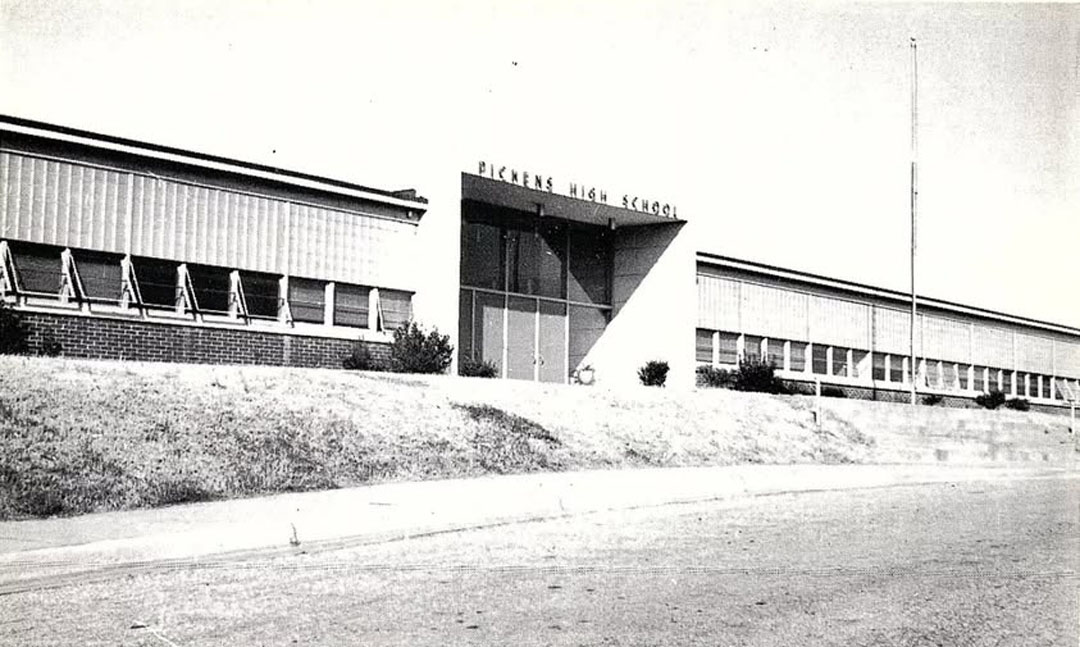
Pickens High School, built in 1954 and utilized for five decades
Hood said that he kept a journal when he was growing up and also collected items from his childhood. “When I was a kid, I was kind of a pack rat for memorabilia. I kept scrapbooks of a lot of my school papers and ticket stubs and newspaper clippings and pamphlets, things like that. And I kept a diary. It wasn’t a typical diary, like ‘I got up, and I did this and that.’ It was more of a journal. I didn’t write in it every day, but I wrote stories about what was going on in junior high school and high school. I realized, when I got to college, that was pretty valuable information, because it’s amazing how quickly you forget some of the details. When the computer age came, I typed it all up, and I’ve been working on it for the last 20 years.” For the past few months, he has been working on getting it completed and doing research on the area. “I decided, I’ve already got it written, let me work on it and get it published and make sure that all the proceeds are dedicated to this fund. So, that’s what we’ve done. Whatever we make will go back into the community.”
Hood and his brother, Frank Hood, together have written nine books on the Submarine Force. “He was a submariner, and, over the last eight years, we’ve published nine books on the history of the U.S. Submarine Force, and we did it to raise money for the Submarine Force charities. We ended up raising $65,000. When I wrote my submarine books, I interviewed hundreds of people for these nine books, and most of them were 80 to 90. A couple of people were over 100 that were in World War II. So, I got pretty adept at interviewing old people. I tell people, ‘If you go to a nursing home, you’re actually going to a group of historians.’ People say, ‘I need to go visit so and so,’ and my response is, ‘Well, go visit them, because they’re not going to be there forever. Spend some time. Take a tape recorder. Or just video them. And get their stories before they pass away, because, once they go, their stories die with them.”
During his recent research, to include some history about Pickens in his book, Hood was gifted with a loan of several scrapbooks that had belonged to the late Blanche Hannah, of Pickens (an author and this writer’s grandmother, who passed away at the age of 91 in 2013). Hannah’s youngest daughter, Martha, loaned them to Hood when she found out that he was writing a book about Pickens. “Martha’s Mom kept these binders full of old newspaper clippings,” he said. “They’re huge. So, I was able to go through her Mom’s old memorabilia, and I pulled out so many interesting little nuggets of history that I was able to work into the book. She had all sorts of interesting stuff that I don’t think I’d be able to find online. So much of it was stuff like the Pickens railroad, and she had a bunch of stuff about McKinney’s Chapel, about Nine Times and how it got its name, and about how Preston McDaniel Road got its name — just tons of little nuggets of stuff, and it was really fun to go through. I did a lot of research to write the book, and I’ve learned a lot that I didn’t know. It’s always fun to find out something else that you didn’t know when you’re perusing something like that.
“I wrote a chapter about the modernization of Pickens and especially the three things that happened during the middle of the last century, which was electrification, school consolidation, and the development of the Cannon Memorial Hospital. In her collection, she had a picture of a map of Pickens County from a 1968 Pickens Sentinel. She cut it out, and it was a map showing all 52 individual school districts before Pickens County developed the Pickens County School District. Before they consolidated, they had 52 individual schoolhouses scattered throughout the county. A few of them are still around. The one at Oolenoy is now the Oolenoy Community Center. The one at Wolf Creek, someone just renovated it into a house. It’s really cool. When I was at the nursing home, talking with Mrs. Dalton, I talked to a 92-year-old man who grew up at Mile Creek and went to one of these schoolhouses, and he ‘gave me the skinny’ on what the school day was like and how they got fed and had no running water, no electricity, no pencil, no paper. They just used slate boards and chalk. It’s important, I think, for people to realize just how far we’ve come.”
Hood mentioned about other chapters in his book: “I have a chapter on Pickens roads, how they were built, how they were named, how they were changed over the 20th century. I have a chapter on Andrew Pickens, why the town is named after him.” Hood also wrote a chapter about Pickens County’s four Medal of Honor recipients, a chapter about natural scenic areas around Pickens County, and a chapter about names in Pickens County, such as the town of Central being named Central during the beginning of the railroad, because of being halfway between Atlanta and Charlotte. “I have chapters about people that were influential in my development, like Mrs. Dalton, my seventh grade math teacher, Jason Smith, my gym teacher, Bill Isaacs, the famous Pickens High School coach. I was fortunate to be able to get to know these people or have interactions with them as I was going through my adolescence. So, there is a lot of history in there about Pickens.”
Speaking about Pickens County’s namesake, Revolutionary War General Andrew Pickens, Hood said, “I went through Pickens Junior and High School, and I don’t remember a single time where one of my history teachers said, ‘This town is named after Andrew Pickens, and here’s who Andrew Pickens was.’ I didn’t know who he was.” Hood spoke of reading the book The Life and Times of General Andrew Pickens, written by Rod Andrew, Jr., an historian and professor of history at Clemson University. “It’s a great biography,” Hood said. “And I did other research. I wrote an essay called ‘Who is Andrew Pickens and Why Should I Care.’ I think it’s appropriate to know that before the country reaches its 250th birthday next year, because he was one of the main reasons that we became a country. There’s so much great history. I still have a textbook from the seventh grade. When you look at the Revolutionary War, most of the discussion is about Lexington and Concord, Boston, Philadelphia. The South gets a paragraph, where they talk about the Battle of Cowpens and the Battle of Kings Mountain. Most of the war was won here, and most of the key battles were fought in South Carolina and North Carolina. I was really interested in writing that chapter, because I’m very interested in history.”
Hood is also interested in natural scenery in Pickens County and includes a chapter on that in his book. “One thing a lot of people who live there their whole lives don’t necessarily think about is just how much natural beauty is around them, and you wonder how many people have gone up to Glassy Mountain, for example, and have taken that short walk to the North Face to look over the Oolenoy Valley there and the mountains. That’s an inspiring view. I do have a chapter in my book about natural attractions and a little history about them, maybe encouraging people to get out and enjoy the beauty they’re blessed to live around. I live in Irmo. We don’t have any mountains here. I live on the lake, so it’s beautiful, but we don’t have any mountains. So, whenever I get up to the Upstate, and I first see the mountains in the distance, I’m home.”
Hood recalled various jobs he held in Pickens when he was young. “I worked at Bi-Lo with Mr. Carl Brooks. I worked at Revco. I worked at the downtown Keowee Pharmacy on East Main Street. I was the last soda jerk there. The soda fountain closed in 1976. I was the soda jerk after school and on weekends. I wrote a fun chapter about that experience. They had regular customers, like Mayor Earle Findley, and the pastor of First Baptist Church, Dr. Lloyd Batson.”
Hood recalled other memories: “people cruising Main, the sidewalk sales that we used to have, the fire alarm going off every Saturday at noon. There are a lot of those details. People have said, ‘How did you remember all this stuff?’ It’s not that I remember it. It’s just that I kept a good journal.”
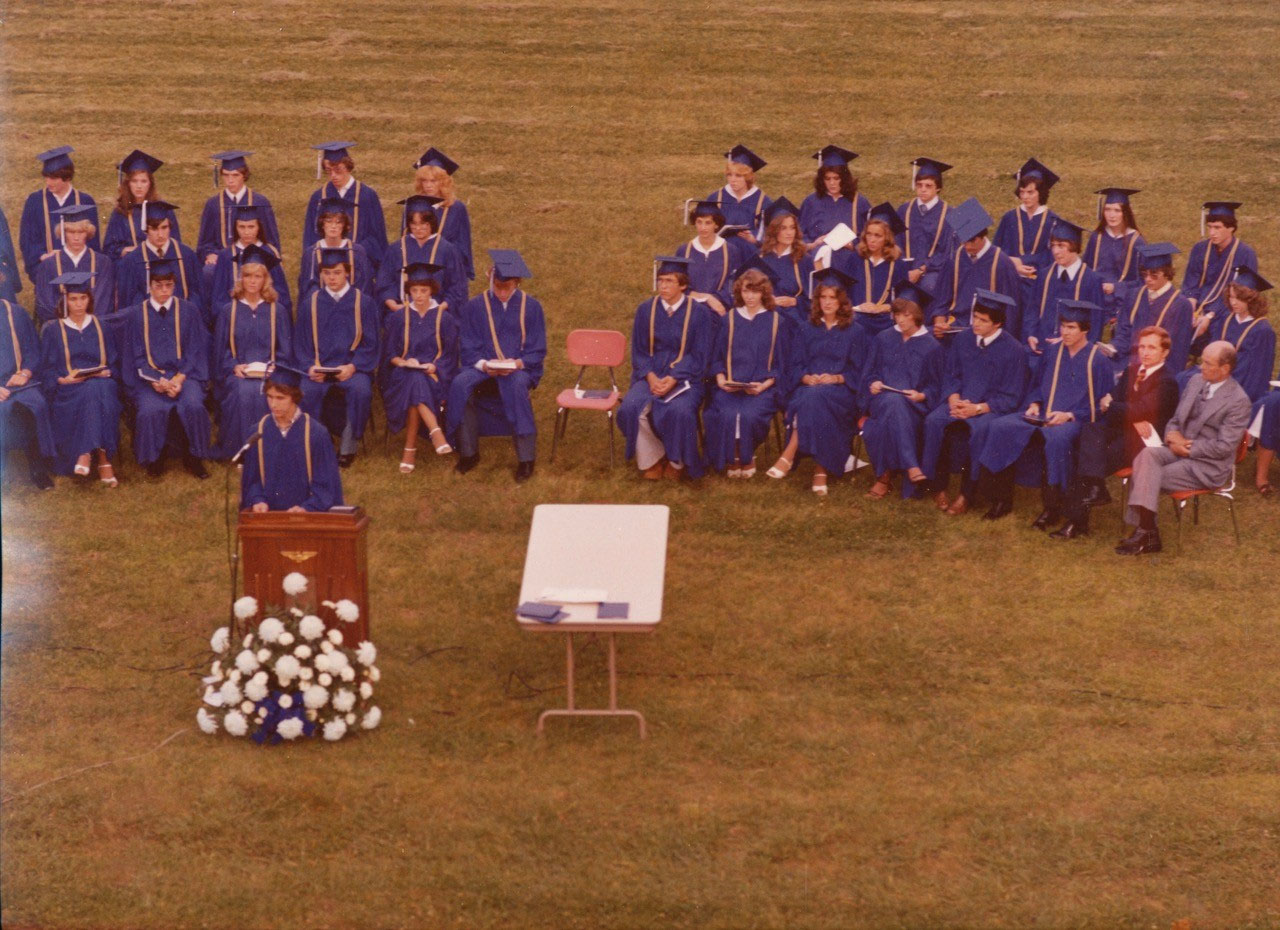
Charles Hood giving his valedictorian speech to the Pickens High School Class of 1979. (Photo courtesy of Charles Hood to The Pickens County Chronicle)
Hood graduated as valedictorian from Pickens High School in 1979. “Through college, I worked at Cannon Memorial Hospital and ended up going to medical school and becoming a physician, in large part because of the experiences that I had working as an orderly during my college years at Cannon. I was actually at the old hospital the last year it was there, before the new one opened in 1982.
“When I went to Medical School, I didn’t have as much free time, but, whenever, I could get away, I came back home. My Mom was still living there by herself. I was the youngest child of six. Everyone else had moved away and married. She ended up moving, because of health issues, in 1990, but I still kept coming back to see my friends, and we built our cabin in 2015.”

Charles Hood (Photo courtesy of Charles Hood to The Pickens County Chronicle)
Hood’s book, Looking for Space: My Pickens Journey, is available for purchase at Amazon.com, both in print format and in digital format. The book is more than 600 pages. “There are probably 300 pictures in there,” said Hood. “A lot of interesting historical pictures are in there.”
He will also give a talk about his book at the Village Library branch in Pickens next month at 5 p.m. on Friday, September 19 and will have his books available for sale. Margaret Holder, branch manager of the Village Library, went to his church in Pickens when Hood was growing up, he said. “I’m pretty sure I baby sat her at least once,” he said. “She’s married to one of my classmates. She wants me to do some reading from the book and have a Q&A and bring some books in case some want to buy them. It sounds like a fun event.”
Wednesday, August 6, 2025